
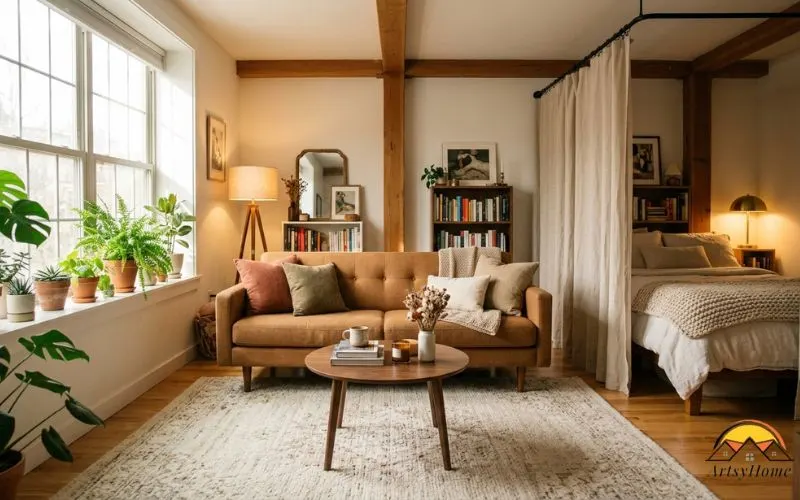
My first studio was 412 square feet, barely bigger than a hotel room. I put the bed under the window because there was nowhere else for it, shoved a couch against the far wall, and just felt cramped for eight months straight.
These 50 studio apartment ideas are fixes I actually tested, across three different tiny rentals I’ve called home. Numbered. Ranked by how much they actually helped.
If you do nothing else, start with these five studio apartment ideas:
- Sketch your floor plan to scale before you buy anything.
- Decide where the bed goes, as far from the door as possible.
- Pick one divider: a shelf, a curtain, or the back of your sofa.
- Kill the overhead light and add two warm lamps.
- Put down one big rug to anchor the living zone.
Table of Contents
How do you plan a studio apartment layout?
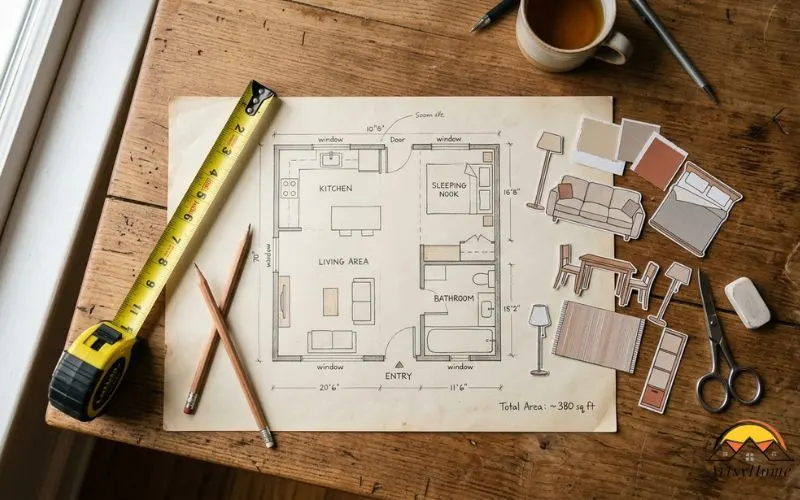
Zoning comes before buying, that’s the one thing every good studio apartment idea agrees on. A working studio apartment layout means deciding where you’ll sleep, sit, work, and eat before you shop for any of it. Buy furniture blind and it just floats in the middle of the room, going nowhere.
1. Zone the room before you buy anything
Zone the space on paper first: a sleep corner, a sitting area, a work nook, an eating spot. I skipped this in my first place and everything fought for one corner. Ten minutes of planning saves months of shoving furniture around.
2. Sketch a floor plan to scale
Measure the room and draw it out before you spend a dime. I use MagicPlan on my phone; graph paper works too. Seeing the layout to scale stops you from buying a compact loveseat that swallows the only walkway, which I learned the hard way.
3. Place the bed first, away from the door
The bed’s the biggest thing you own, so it decides the whole plan. Put it as far from the front door as you can, ideally in a corner or alcove. You want to see the living zone first when you walk in, not your pillows.
4. Keep clear walking paths
Leave a clear lane from the door through the room, at least shoulder width. Empty floor isn’t wasted space; it’s what keeps a studio from feeling packed. I resist the urge to fill every corner, and the whole place breathes for it.
Studio apartment ideas that make the room feel bigger
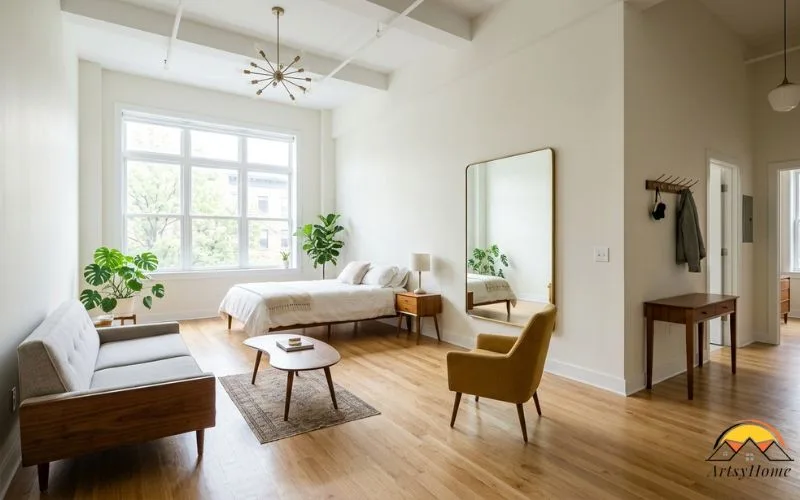
Small studios feel bigger the second your eye can travel across them without snagging on something. Open sightlines, furniture lifted off the floor, daylight that actually bounces around; none of it costs much, and it carries straight over to any small living room, too.
5. Choose leggy, low-profile furniture that shows the floor
Furniture on visible legs lets light and floor show underneath, so the room reads airy. I swapped a boxy skirted loveseat for a mid-century one on 6-inch legs, and the same square footage suddenly felt open. Skirted bases sit heavy and shrink a space.
6. Paint one calm color, floor to ceiling
Busy walls chop a room up. One quiet color across the walls, and even the ceiling, blurs the corners so your eye can’t measure how small it is. I used Farrow & Ball’s Cornforth White; a $45 Behr dupe does the same job.
7. Hang the curtains high and wide
Mount the rod near the ceiling and stretch it past the window frame. It fakes taller windows and a taller room in one cheap move. I hang mine about 6 inches below the ceiling and let the panels just kiss the floor. Instant lift, zero construction.
8. Keep the windows clear and let the light travel
Nothing shrinks a studio like a blocked window. Skip heavy drapes and bulky furniture in front of the glass; a sheer panel keeps privacy while the light pours through. I moved my dresser off the window wall and the place brightened like someone turned up a dimmer.
9. Put a big mirror opposite the window
A large mirror across from a window bounces daylight and fakes depth better than anything. I leaned a $40 Target mirror opposite my only window and the light doubled. Lean it instead of hanging so you can move it when the layout shifts.
10. Add a full-length mirror on a door for dressing
A full-length mirror you can actually get dressed in doesn’t need floor space if you hang it on the closet or bathroom door. I stuck a $25 IKEA door mirror on mine. It checks outfits and bounces a little extra light, and it never touches the floor.
How do you divide a studio apartment without building walls?
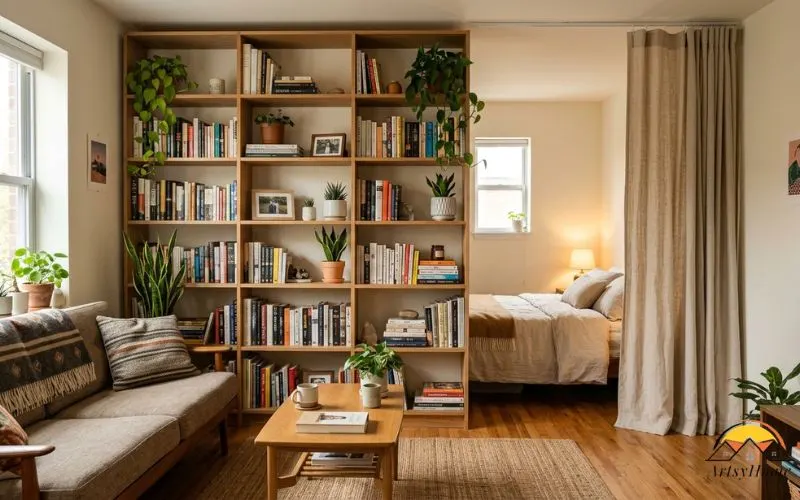
Drywall isn’t the only way to split a room. Furniture and fabric do the job just as well, a bookshelf, a ceiling curtain, the back of a sofa, even a rug can work as a room divider your brain will read as a real boundary. Just keep dividers low or see-through, so the light keeps moving through the room.
11. Split the room with a bookshelf
My favorite divider is an IKEA KALLAX, the 4×2 stood tall at about 58 inches. It splits the space, holds books on one face, and shows plants on the other. Storage and a wall in one piece, which is the whole game in a studio.
12. Curtain off the bed from the ceiling
Run a track across the ceiling and wall off the bed in one swipe. I used a $12 IKEA VIDGA rail and a linen panel from Amazon, under $50 total. Pull it at night, tuck it by day. Guests read it as a real bedroom instantly.
13. Float the sofa as a divider
Stop shoving the couch against a wall. Float it, and the back becomes the line between living and sleeping. Add a slim console behind it for a lamp and the mail pile. This one costs nothing, and I wish I’d done it in year one.
14. Zone the floor with a large rug
No shelf, no curtain, no problem. A rug under the seating draws an invisible border the eye respects. I run a 5×8 under the sofa with the front legs on the rug, and the living zone appears. Different rug by the bed, different room.
15. Add a folding screen for instant privacy
A three-panel folding screen hides a mess or a bed in seconds and folds flat when you don’t need it. I keep a $60 rattan one from Wayfair by the bed for when people drop by. Cheaper than a curtain track, and you can move it anywhere.
Where should the bed go, and which one should you buy?
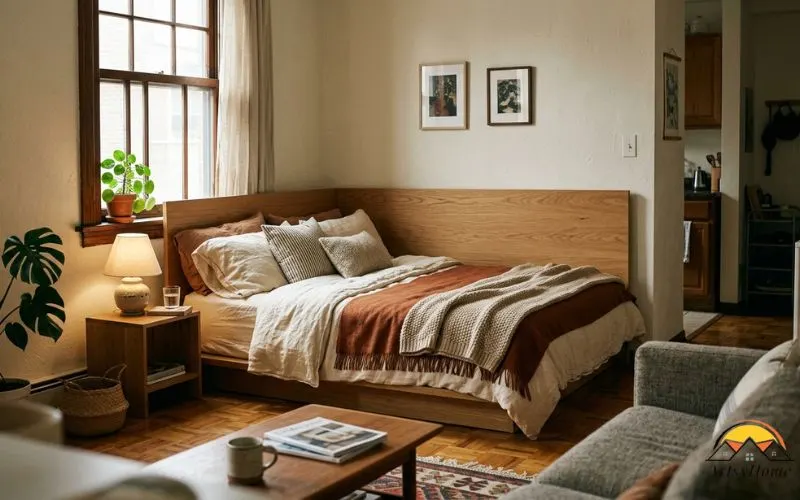
Figure out placement before you shop for the frame. Tuck the bed away from the door first, then look for one that folds, lofts, or hides storage underneath. A studio bed can’t just be a bed. It has to earn its spot.
16. Install a Murphy or wall bed
A Murphy bed folds up and hands back the roughly 30 square feet a bed normally eats. Resource Furniture and Bestar both make good ones; I priced a Bestar near $1,400. Pricey, sure. But under 400 square feet, it’s the difference between a bedroom and an obstacle.
17. Use a sofa bed or daybed
No budget for a wall bed? A sofa bed or daybed pulls double duty. My IKEA FRIHETEN cost $549 and turned the living room into a guest room in ten seconds.
The catch: cheap ones sleep like a park bench. Test the mattress or add a topper.
18. Loft the bed and steal the floor beneath
If your ceilings clear 9 feet, a loft bed opens a whole floor underneath. I’ve seen people fit a desk, a chair, even a tiny closet down there. Best square-foot math in any studio. Just know you’ll climb a ladder at 2 a.m., which gets old.
19. Choose a platform bed with drawers
If you want zero fuss, a platform bed with built-in drawers is the quiet workhorse. Six drawers under a queen swallow off-season clothes and bedding no studio closet can hold. Floyd and IKEA’s NORDLI both do it. Least glamorous, most useful bed you’ll own.
Here’s how the main sleeping options stack up.
| Bed solution | Best for | Rough cost | My honest verdict |
| Murphy / wall bed | Studios under 400 sq ft | $1,200 to 2,500 | Worth it if you host or work from home |
| Sofa bed / daybed | Tight budgets, guests | $400 to 900 | Buy once, buy decent; cheap ones wreck sleep |
| Loft bed | Ceilings 9 ft and up | $300 to 1,200 | Best space math, hardest on your knees |
| Platform with drawers | Renters wanting storage | $250 to 800 | The quiet workhorse, and my default pick |
Multifunctional furniture that earns its footprint
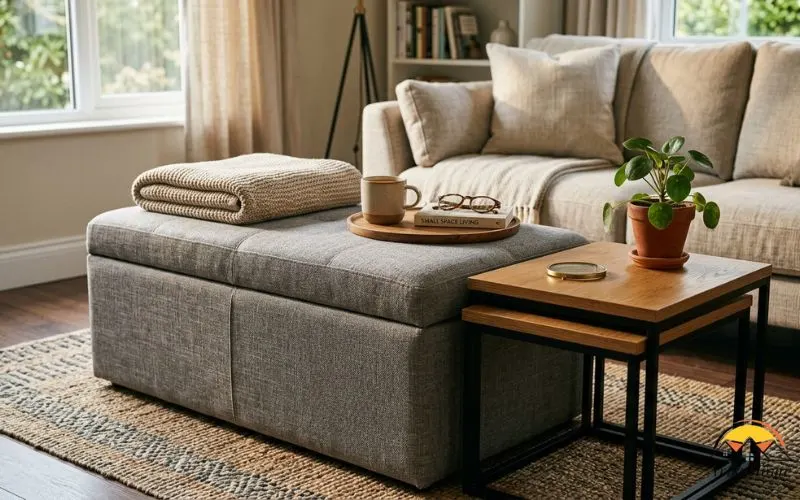
In a studio, every piece earns its keep by doing at least two jobs. Multifunctional furniture, think storage ottomans, nesting tables, convertible consoles, is really the only kind that lasts in a small space. Anything that does just one job is quietly costing you room you don’t have.
20. Get a storage ottoman
My storage ottoman from Article holds every winter blanket I own and doubles as a coffee table and a spare seat. Three jobs, one 30-inch square. I stole the idea from boat owners: nothing comes aboard unless it stores something, folds, or converts.
21. Use nesting and lift-top tables
Nesting tables are quietly brilliant. One little table most days, three when people show up. CB2 and West Elm make good sets; mine were $99 from a thrift store. A lift-top coffee table does the same, hiding clutter and rising to eat over.
22. Try an expandable console-to-dining table
A console that expands into a dining table is the fancy version of this rule. Slim against the wall daily, seats six on a holiday. Resource Furniture’s Goliath is the icon at a steep price; Wayfair sells dupes under $300. Worth it if you host and can’t spare the floor.
23. Put the TV on a swivel wall mount
Bolt the TV to a swivel arm instead of a console and you free up a whole surface, plus you can angle it to the bed or the sofa. I used a $35 mount rated for my 50-inch. One less bulky piece of furniture eating the floor.
24. Put big pieces on casters so the room can shift
Screw casters onto your heaviest pieces, the bookshelf, the bar cart, the bed, and the whole studio becomes reconfigurable. I roll my KALLAX aside when friends come over and the room opens up. Locking wheels hold everything still the rest of the time. Ten dollars of hardware, endless flexibility.
Studio apartment ideas for a kitchen and dining zone
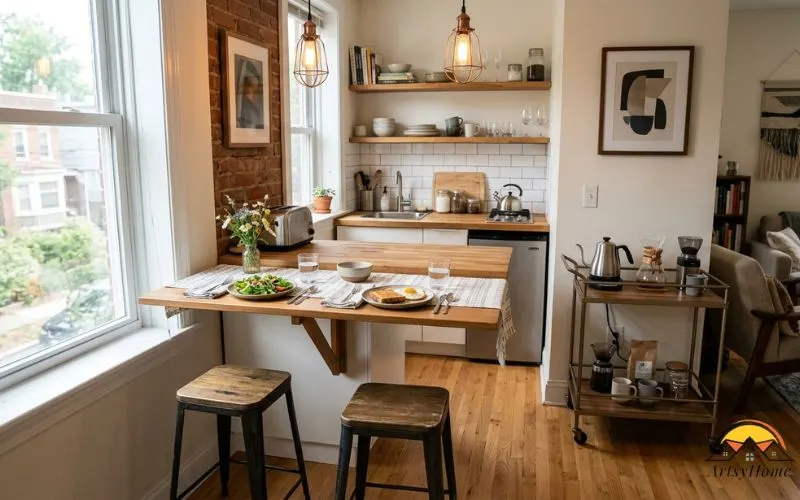
Most studios give you a kitchenette and nothing to eat at, so you end up building a dining space that folds away. A drop-leaf table, a bar cart, stools that tuck under the counter, all of it gives you somewhere to sit that vanishes once the meal’s over. Eating on the couch every night gets old fast, trust me.
25. Use a drop-leaf or gateleg table
A gateleg table flat against the wall seats one on a weeknight and four on a Friday. Mine’s a $130 IKEA NORDEN; the flaps fold down and it nearly disappears. Best dining fix I’ve found for a studio where a full table would block the whole room.
26. Roll in a bar cart for counter space
When the kitchen has no counter, a bar cart becomes prep space, coffee station, and bar on wheels. I rolled a $70 one next to the fridge and finally got the counter I never had. Roll it out of the way when you need the floor.
27. Add stools that tuck under the counter
Two backless stools that slide fully under the kitchenette overhang give you seating that takes no floor. Mine disappear completely when I’m not using them. It’s the difference between a spot to perch with coffee and a cramped corner you avoid.
Where do you put a desk in a studio apartment?
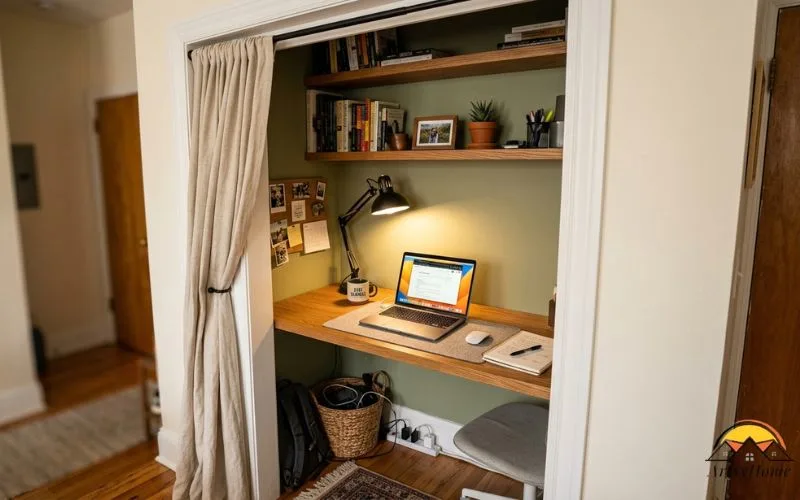
A studio rarely has a spare wall for a full desk, so the best home-office ideas steal a corner, a closet, or a windowsill instead. A closet turned office, a fold-down shelf, a desk that doubles as a nightstand, any of these turns dead space into somewhere you can actually work. And for most of us, a work zone isn’t optional anymore.
28. Build a closet cloffice
I turned a reach-in closet into an office: pulled the doors, dropped in a $90 IKEA countertop and a shelf, and closed it off with a curtain at 5 p.m. Cleanest work-life split a studio allows. The bed’s ten feet away and I still leave work.
29. Mount a drop-down wall desk
A wall-mounted fold-down desk gives you a workspace that vanishes at 6 p.m. IKEA’s NORBERG folds flat to about 4 inches deep. I mounted one by the window for around $70. Working from the bed wrecks your back and your sleep, so this earns its wall fast.
30. Let a slim desk double as a nightstand
A narrow desk beside the bed works as a nightstand too. Lamp and charger by night, laptop by day, one surface doing two jobs. I used a 40-inch Wayfair writing desk and skipped buying a nightstand entirely. Two needs, one footprint, the studio rule again.
Storage ideas for a studio with no closet
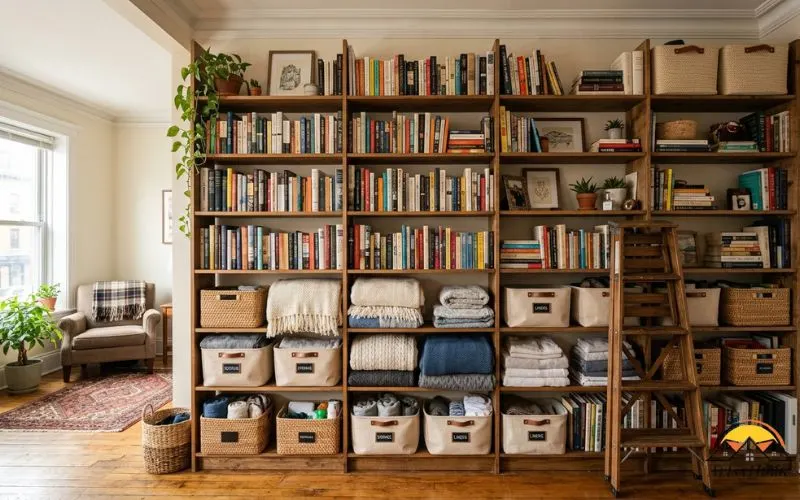
Go up, not out. That’s really the whole strategy here. Vertical storage, meaning tall shelves, over-door racks, under-bed bins, is the only direction left to grow into. Floor space runs out fast; wall space and the space under your bed almost never do. There are more small space storage ideas where that came from.
31. Go vertical with shelves to the ceiling, or a storage wall
Most people fill 5 feet of wall and leave the top 3 feet bare, a whole extra bookshelf ignored. I run IKEA BILLY units to the ceiling and keep a step stool behind the couch. Long-term, a built-in storage wall can even hide a fold-down bed and replace a closet.
32. Use over-door and behind-door racks
Every door is storage you already pay rent on. An over-door rack holds shoes, cleaning bottles, or pantry cans; a $15 mDesign one reclaimed a full shelf for me. 3M Command hooks inside the closet door hold bags and belts. Free real estate you’re ignoring.
33. Turn the windowsill into a shelf
A deep windowsill is free shelf space most people ignore. I line mine with a few small plants, a short stack of books, and a candle, and it frames the window while saving a whole side table. Just don’t block the light; keep it low and sparse.
34. Slide bins under the bed
The gap under the bed is prime real estate people forget. Flat rolling bins hold shoes, luggage, and off-season clothes out of sight. I use $20 IKEA SKUBB boxes on casters. If your frame sits low, bed risers buy a few more inches of clearance.
35. Double-hang the closet, or add a garment rack
A single closet rod wastes half the height. A $20 double-hang rod instantly doubles your hanging space for shirts and folded pieces. No closet at all? A slim garment rack or a freestanding IKEA PAX becomes one, and it looks intentional if you keep it tidy.
36. Run one in, one out
Storage tricks fail if you keep buying. So I run a hard rule: one thing in, one thing out. New sweater, old sweater goes. A UCLA study even linked cluttered homes to higher daily stress-hormone levels, and I felt exactly that my first year.
How do you make a studio apartment cozy instead of cramped?
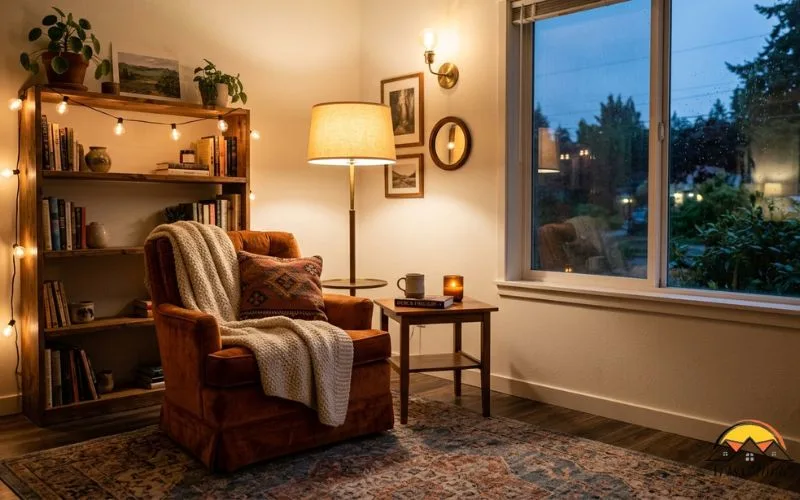
Turn off the overhead light and build up softer ones instead. Cozy isn’t about cramming in more stuff, it comes from low, warm layered lighting, one big rug, and a handful of things you actually love. A single harsh ceiling bulb can make any small room feel like a waiting room.
37. Kill the overhead and layer three lights
Designers push at least three light sources per room: ambient, task, and accent. In a studio that’s a floor lamp, a desk lamp, and a string of warm bulbs. I run Philips Hue at 2700K, the warm end, and the whole box feels softer at night.
38. Mount sconces or pendants to save floor space
A floor lamp eats a square foot you can’t spare. Swap it for a plug-in wall sconce or a hanging pendant and you get the same glow with none of the footprint. I hung two $30 sconces beside the bed as reading lights and reclaimed both nightstands.
39. Lay one big rug, not three small ones
Scattering little rugs chops the floor into confetti and shrinks the room. One large rug pulls it together and tricks the eye into seeing more floor. I went from three $20 mats to one 8×10 Ruggable; here’s how I size rugs.
40. Give the bed a real headboard
A mattress on the floor screams temporary. A proper frame and headboard tells your brain this is a home, not a crash pad. Even an $80 upholstered headboard shifts the whole mood. This did more for how my studio felt than anything else I bought.
41. Style the bed like a hotel
Since the bed’s on display, dress it like a boutique hotel: crisp white sheets, a couple of layered pillows, one folded throw. It sounds fussy, but it’s the fastest way to make a studio read polished instead of dorm-room. Thirty seconds each morning, and it changes the whole feel.
42. Hang one oversized artwork, one statement piece per zone
One big piece of art beats a scattered gallery wall in a small space; the gallery reads as clutter. Better yet, give each zone one statement piece, a bold headboard, a pendant, a single canvas. I hung a 36-by-48 over the sofa and the wall finally felt finished.
43. Bring in a couple of low-effort plants
Plants blur the rigid lines of a small box and make it feel alive instead of staged. A tall snake plant in one corner, a trailing pothos on a shelf. Low-light, low-effort ones only. I’ve killed enough fiddle-leaf figs to warn you off them.
44. Go vertical with hanging planters
Floor plants eat floor; hanging ones don’t. A trailing pothos in a macrame hanger or a row of wall-mounted planters gives you greenery without giving up an inch. I hung three by the window and the corner feels like a garden. Water-catching pots save your floors.
45. Pick one metal finish and stick to it
Pick one metal, brass or black or brushed nickel, and repeat it across your hardware, lamps, and frames. Mixing five finishes makes a small room feel busy and cheap. One finish reads curated and calm. It’s a free upgrade; you’re just choosing what you already buy.
Studio apartment ideas for renters who can’t drill
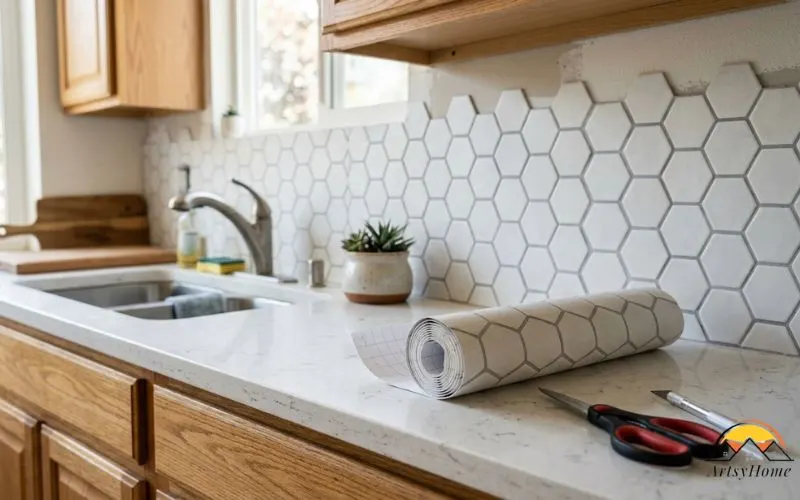
The rule for renters is simple: everything reversible, nothing permanent, because your deposit rides on it. Peel-and-stick tile, removable wallpaper, tension rods, Command strips, these let you transform a rental and then undo all of it in an afternoon. Landlords hold deposits over drill holes and paint, so plan around both.
46. Renter-proof with peel-and-stick and Command strips
I covered a scuffed backsplash with $40 of Smart Tiles, added marble contact paper to the counters, and hung art on 3M Command strips rated to 5 pounds. Moved out, peeled it all off, got the full deposit back. Renting isn’t a reason to live in a beige box.
47. Add a removable-wallpaper accent wall
One accent wall of peel-and-stick wallpaper does more than a room full of decor. I did the wall behind the bed in a $50 Tempaper print, and it read as a designed bedroom. Test a strip first, since textured walls fight the glue. It peels off clean when you leave.
Keep one room from feeling like a mess
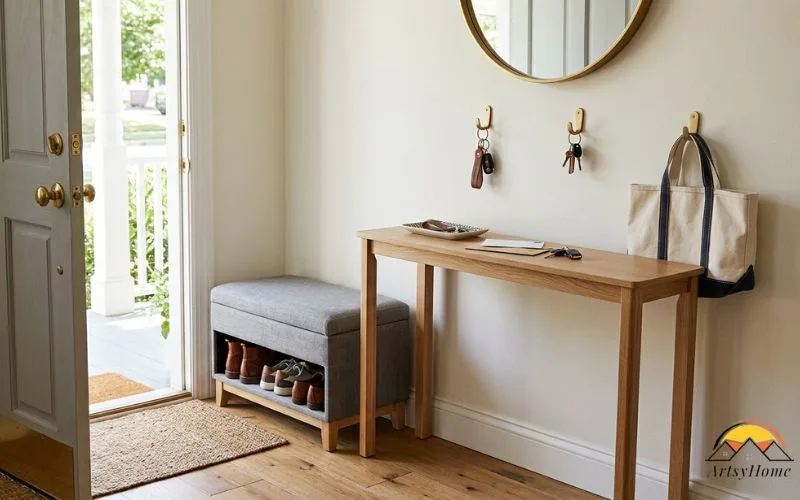
In a one-room home, clutter has nowhere to hide, so a few simple habits do most of the work here. Give everything a home, keep a drop zone by the door, and pick closed storage over open baskets. That’s usually enough to keep a studio from tipping into chaos.
48. Create a drop zone by the door
I hung three hooks and a slim tray by the door for keys, mail, and shoes, and most of my clutter stopped at the threshold. Everything has a landing spot the second I walk in. Mornings stopped being a scavenger hunt for my keys.
49. Choose closed bins over open baskets
Open baskets show the jumble; closed bins hide it. Swapping to lidded, matching boxes on my shelves calmed the whole room, even though the same stuff lives inside. I use IKEA KUGGIS bins. Cheapest visual upgrade around, honestly.
50. Hang a fold-away drying rack
No room for a dryer means a drying rack, and a wall-mounted fold-away one beats the floor-hogging kind. Mine folds flat to two inches when it’s dry. I mounted it over the tub so drips don’t matter. Twenty dollars, and my laundry stopped colonizing the furniture.
Match these studio apartment ideas to your square footage
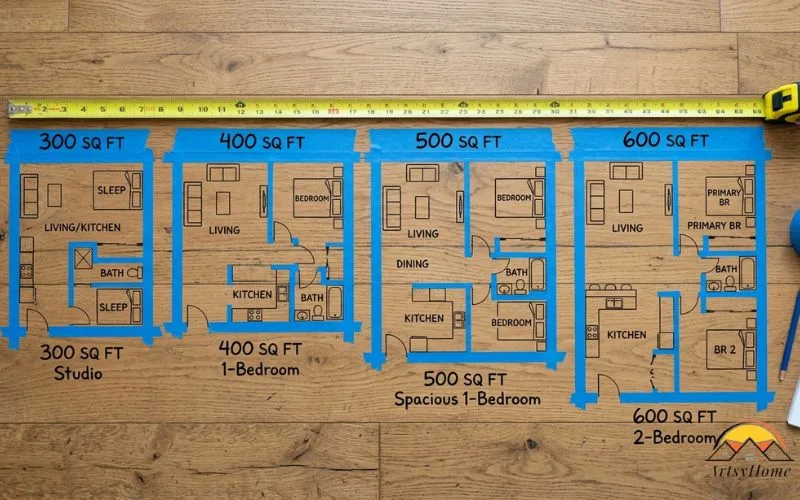
What passes in 550 square feet will sink a 300-square-foot studio. The smallest a studio gets in most US cities is around 300 square feet; micro-units drop to 150 to 250. The average new US studio runs roughly 500 square feet and keeps shrinking, per RentCafe’s apartment-size data.
| Studio size | What comfortably fits | What to prioritize |
| ~300 sq ft | Bed, one seat, fold-down desk | A wall bed or loft; nothing you can’t fold |
| ~400 sq ft | Bed, small sofa, table for two | One divider and real vertical storage |
| ~500 sq ft | Full sofa, bed zone, proper desk | Zoning and one large rug |
| ~600 sq ft | Loosely separate zones | Making it feel intentional, not empty |
Under 400 square feet, my one rule is that everything folds, lofts, or hides storage. I helped a friend cut her micro-studio from eleven pieces to six convertible ones, and it doubled in feel overnight.
Where to spend and where to save on a studio
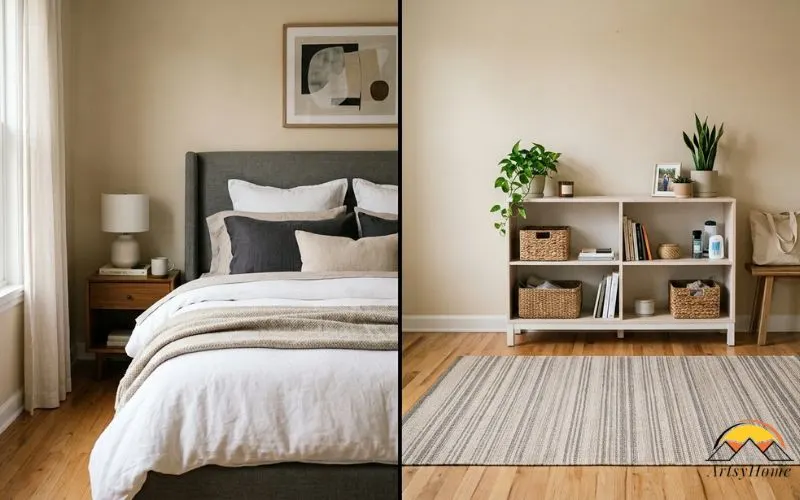
The smartest studio apartment ideas put money where your body goes. Spend on the bed, the sofa, and lighting; save on nearly everything else. I’ve wasted cash both directions: a $900 chair I sat in twice, and a $60 sofa bed that gave me back pain for a year.
| Item | Budget pick | Splurge pick | Worth the splurge? |
| Sofa bed | IKEA FRIHETEN (~$549) | Article or Room & Board (~$1,800) | Yes, if you host often |
| Rug | Amazon flatweave (~$60) | Ruggable or handwoven (~$300) | No, budget looks fine |
| Lighting | Lamps plus smart bulbs (~$80) | Design pieces (~$400+) | Sometimes; the bulbs matter more |
| Storage | IKEA or Elfa shelving (~$100) | Custom built-ins (~$2,000) | No, renters can’t take it |
Is a studio apartment cheaper than a one-bedroom?
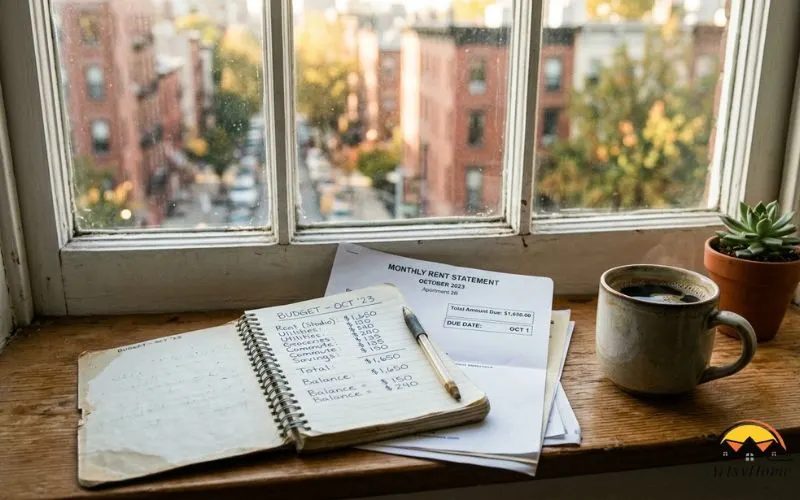
Usually, yes. In the same building, a studio rents for less than a one-bedroom because you’re paying for less square footage, and your heating and cooling bills drop with it. The catch: in a pricey neighborhood, a well-located studio can cost as much as a one-bed further out.
I’ve rented both. My studio ran about $400 a month less than the one-bedroom I left, and the smaller space was cheaper to heat all winter. If you can live with one room, it’s the budget move, plain and simple.
What are the real downsides of a studio, and how do you deal with them?
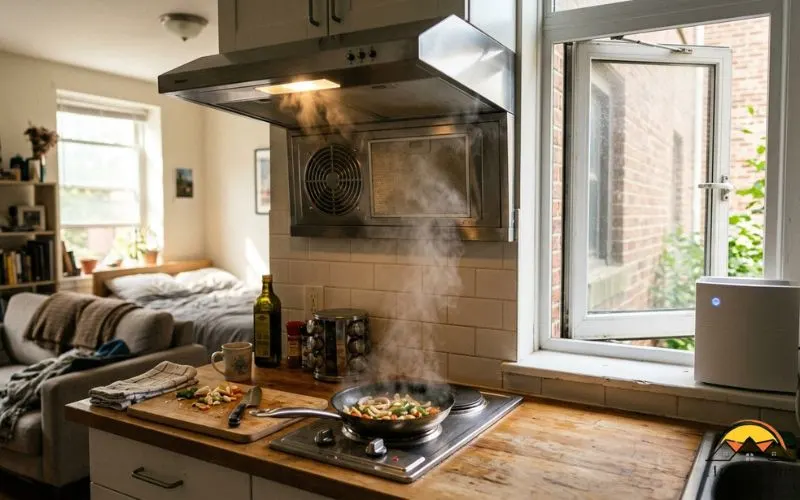
Privacy, cooking smells, and clutter that spreads with nowhere to hide, those are the honest downsides. None of them are dealbreakers, and the right studio apartment ideas handle all three well enough. Here’s how I actually deal with the ones people complain about most.
Cooking smells that fill the whole room
With no wall between the stove and the bed, dinner lingers on your sheets. I run the range hood, crack a window, and keep a $30 Levoit air purifier going while I cook. Cooking with the lid on helps more than you’d think. Fried fish is still a bad idea.
Zero privacy when someone stays over
One room means nowhere to retreat. A curtain or screen around the bed buys instant separation, and it’s the first thing I set up before guests arrive. For a partner, giving each person one defined zone, a desk or a chair, keeps you from living on top of each other.
Clutter with nowhere to hide
In a one-room home, one messy surface makes the whole place look wrecked. Closed storage, a drop zone by the door, and a two-minute reset before bed keep it in check. Stay on top of it daily or it snowballs fast. That habit matters more than any single product.
Studio furniture dimensions worth memorizing
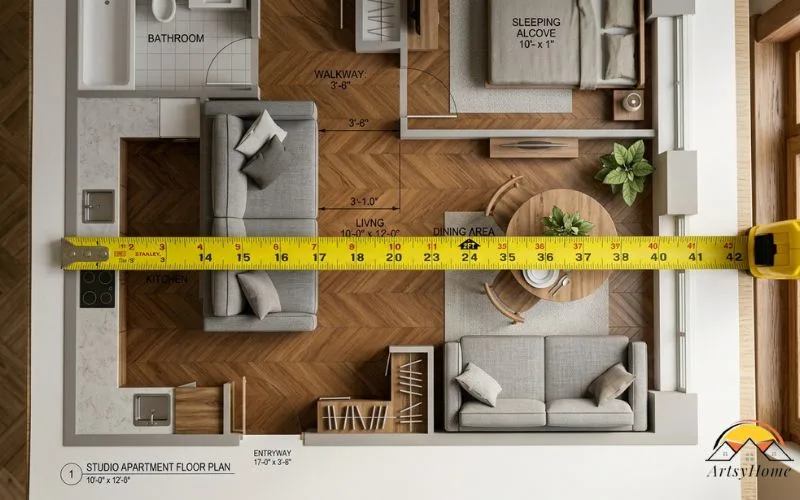
A few numbers stop you from buying furniture that doesn’t fit. Leave at least 24 inches to walk through, 30 to 36 inches around a dining table, and 14 to 18 inches between the sofa and coffee table. Memorize these before you shop.
| Where | Clearance to leave | Why it matters |
| Main walkway | 24 to 30 in | Pass through without turning sideways |
| Around a dining table | 30 to 36 in | Pull the chair out and actually sit |
| Sofa to coffee table | 14 to 18 in | Reach your drink, still walk past |
| In front of a dresser or closet | 30 to 36 in | Open drawers and doors fully |
| Rug border under seating | 8 to 10 in | Anchors the zone without eating floor |
I ignored the 24-inch walkway rule once and wedged in an armchair. I banged my shin on it daily for a month before it went on Facebook Marketplace. The numbers aren’t fussy; they’re the line between a room and an obstacle course.
Studio apartment ideas for different decorating styles

The same small-space rules bend to any look; only the finishes change. A minimalist studio leans on hidden storage and one bold piece, while a boho one layers texture to fill the space warmly. Pick a lane and commit, because a mishmash reads as clutter in a small room.
| Style | How to make it work in a studio | One signature move |
| Japandi / minimalist | Hidden storage, pale wood, empty space | A single low platform bed |
| Mid-century modern | Leggy furniture, walnut tones, globe lights | A statement lounge chair |
| Boho | Layered rugs and textiles, plants, rattan | A curtain or canopy around the bed |
| Industrial | Metal shelving, moody walls, exposed bulbs | A rolling wardrobe rack |
| Traditional | Symmetry, a real headboard, framed art | A skirted bed with storage under |
My studio landed between Japandi and mid-century, and the restraint is exactly what makes it feel bigger. Busy styles fight small rooms, so I let a few good pieces do the talking.
How do you make a studio apartment work for two people?
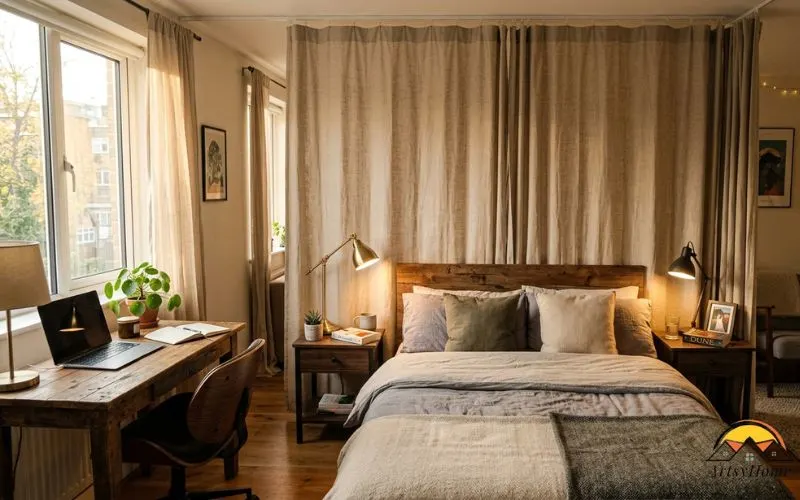
Two people can share one room, as long as each person gets a zone and the storage doubles from day one. Give each person a defined spot, a side of the bed, a desk, a chair, so nobody ends up feeling like a guest in their own home. For couples, the right studio apartment ideas really just come down to clear boundaries.
Give each person their own zone
My partner and I split a 500-square-foot studio for a year. A curtain between the bed and the work area meant one of us could sleep while the other worked. Two reading lights, two nightstands, two hooks by the door. Small ownership, big peace.
Double the storage before you move in
Two wardrobes’ worth of stuff in one closet is a losing game. We added a second garment rack and under-bed bins for each of us before unpacking a box. Sort storage first; fighting over closet space later is miserable and completely avoidable.
Studio apartment ideas for pet owners
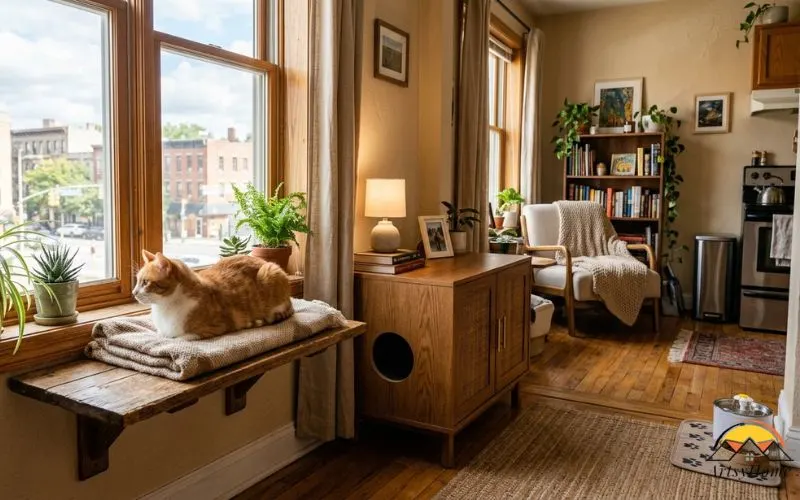
A pet can absolutely work in a studio, as long as the gear stays hidden and the floor stays clear. A litter box tucked into a cabinet, a feeding station kept off the main walkway, some vertical space for a cat; that combination keeps a small place from turning into a kennel. I’ve lived in a studio with a cat, and honestly, it’s fine with a little planning.
Hide the litter box and feeding station
An open litter box in a one-room home is grim. I used a cat-washroom cabinet that looks like furniture and vented it toward the window. Feed off the main path so nobody trips the bowls. A small mat under them saves your floor from scatter.
Give a cat or small dog vertical room
When the floor’s tight, animals need up. A couple of wall shelves or a tall cat tree in the corner gives a cat somewhere to roam without eating your square footage. My cat lives on the shelves, and the floor stays mine.
How to handle noise and air in a small studio
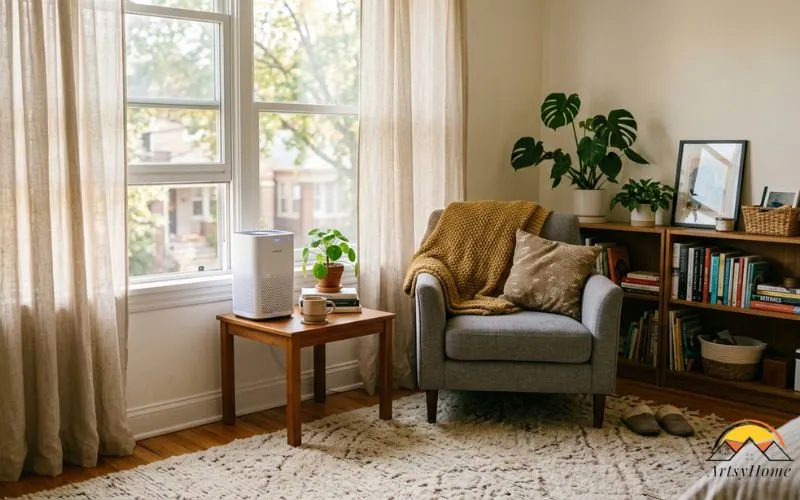
When you sleep and cook in the same room, sound and air quality matter more than usual. Soft surfaces soak up noise, and a small purifier with a cracked window keeps the air from turning stale. An empty, hard-surfaced studio traps sound and smell alike, so soften it and keep it ventilated.
Soften the echo with textiles
A big rug, curtains, and a fabric headboard kill the hollow echo an empty box makes. I added an acoustic panel disguised as art behind the desk for video calls. Renters can use peel-off felt panels. Cheaper than you’d guess, and the quiet is instant.
Keep the air moving
One room means cooking, sleeping, and breathing share the same air. I run a $30 Levoit purifier and crack a window daily, and I keep a small dehumidifier going in summer so bathroom steam doesn’t linger. Stale studio air is a solvable problem, not a life sentence.
How to shop for a studio without overspending
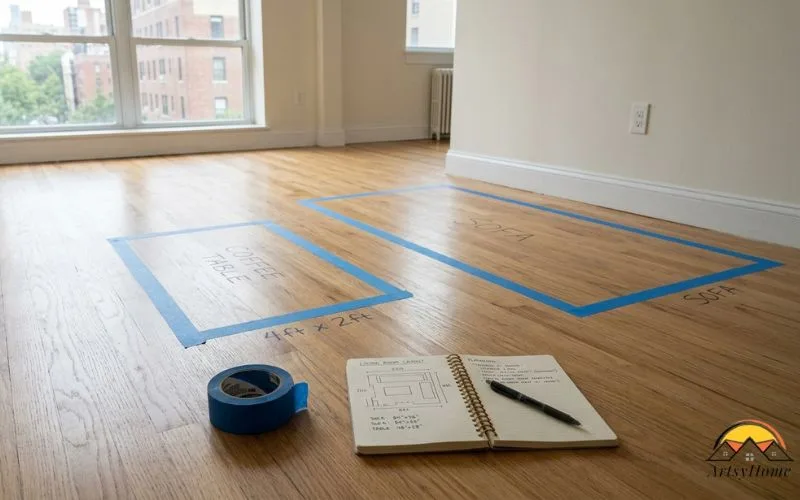
Measure first, tape it out, buy convertible, then wait for a sale, roughly in that order. Most of the money mistakes come from buying before the space is mapped out, or paying full price because you got impatient. I’ve made both mistakes, so learn from my receipts.
Tape the footprint on the floor first
Painter’s tape is free, and it’s saved me hundreds. I outline a sofa or table on the actual floor and live with it for a day. Half the time the piece I wanted is too big, and the tape tells me before the delivery truck does.
Buy convertible, and buy it on sale
In a studio, single-use furniture is a luxury you can’t afford, so I only buy pieces that fold, store, or convert. And I wait. IKEA and Wayfair run sales constantly, and Facebook Marketplace is full of barely-used furniture from people who upsized. Patience is a discount.
Your first week in a new studio
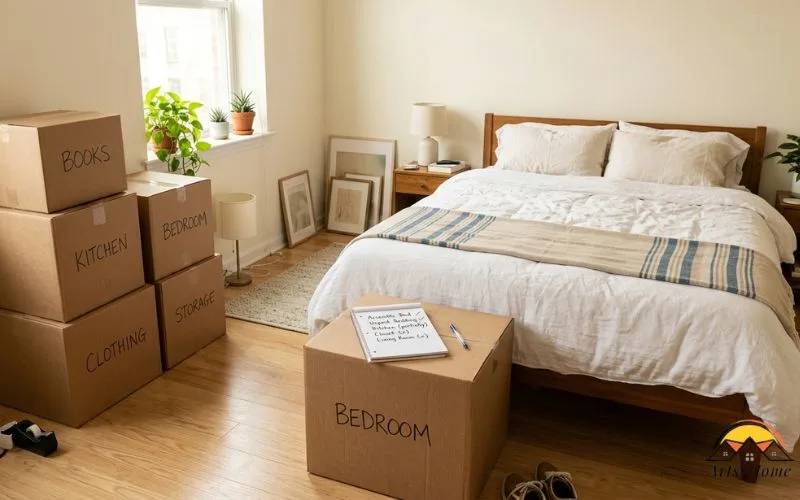
Do these in your first week and the space starts working right away. Order matters, because hanging art before the furniture’s placed just means re-hanging it. Here’s the sequence I follow every move.
- Deep-clean the empty space and note the light each wall gets.
- Place the bed first, as far from the door as possible.
- Set your zones with a divider and a rug.
- Assemble all your storage before unpacking a single box.
- Position the sofa and any convertible furniture.
- Swap the overhead bulb and add your lamps.
- Hang the art and mirror last, once everything’s in place.
A walk through my current 380-square-foot studio
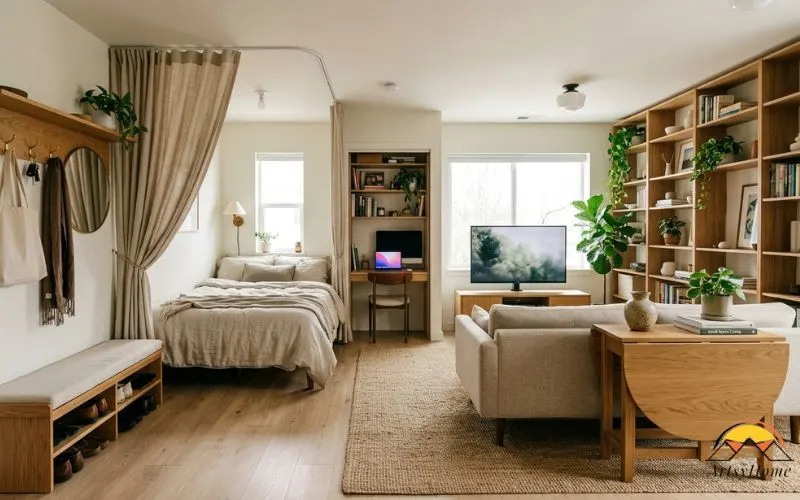
Here’s how all of this looks stitched together in one real place. My current studio is 380 square feet, and every one of these studio apartment ideas earns its spot. Nothing here is theoretical; I live in it, trip over it, and love it.
People assume a studio this size means sacrifice. It doesn’t. It means every choice has to be deliberate, and honestly, that constraint made me a sharper decorator than any big apartment ever would have.
The door and the drop zone
Walk in and there’s a slim console with three hooks, a tray for keys, and a full-length mirror on the closet door. Shoes go in a covered bench. The mess stops right here, at the threshold, which is the entire point of a drop zone.
The sleep-and-work wall
The far wall holds the bed in a nook behind a linen curtain, a $90 closet cloffice beside it, and BILLY shelves to the ceiling. Two sconces replaced the nightstand lamps. It reads as a bedroom and an office that both vanish behind fabric by day.
The living-and-eating side
A floated sofa on 6-inch legs faces a swivel TV, an 8×10 rug marks the living zone, and a $130 gateleg table folds down by the kitchenette. One oversized canvas anchors the wall. Guests never guess it’s 380 square feet until I tell them.
The studio apartment mistakes I’d undo if I could
Biggest one, I bought furniture before measuring, so a compact loveseat blocked the only walkway for a year. Measure the doorway too. My couch nearly didn’t fit through it, and I found out on delivery day, sweating in the hallway.
Second, I hung art before fixing the layout, then re-hung everything twice. Flow first, style second. And skip the tiny scatter rugs; they cost me twice, once to buy, once to replace with the big rug I should’ve bought first.
The one rule I’d give any new studio renter
Zone first, measure twice, make every piece do two jobs. Get that right and 400 square feet stops feeling like a compromise.
Your studio won’t look like a magazine, and it shouldn’t. It should look like the smartest use of your four walls. Start on the floor plan this weekend.