

When it comes to porch ceiling ideas, I learned the hard way. My first porch ceiling cupped like a potato chip within one humid August because I’d skipped sealing the backs of the cedar boards.
That single mistake taught me more about porch ceiling ideas than any showroom ever could. So here’s the version I’d hand a friend: what lasts, what’s a money pit, and what I regret.aaa
Table of Contents
What can you put on a porch ceiling?
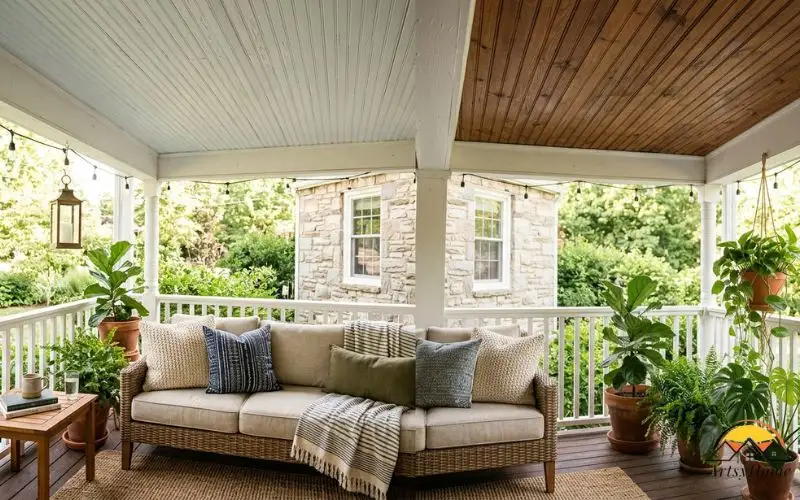
More options than you’d think, as long as they’re built to live outdoors. Tongue-and-groove boards. Beadboard or cellular PVC. Fiber cement, vinyl or aluminum soffit, humble exterior plywood. Or nothing at all, if bare beams are your thing.
That finished underside overhead has a name, by the way. It’s your porch ceiling (a builder might call it the exterior soffit, same difference). And the one material I’ll never let near a porch is drywall. It sags, it molds, it falls apart out there inside a season.
What tips the decision? Three things, pretty simple ones. Your budget. Your local weather. And how much fussing you’ll tolerate down the road. A shaded back porch is forgiving and takes almost anything. A coastal front porch that bakes in salt spray and afternoon sun? Fussier customer. Here’s the cheat sheet I wish someone had slid across the table to me.
| Material | Materials cost | Best for | Upkeep | DIY-friendly? |
| Exterior plywood + lath | $1-$2 / sq ft | Tight budgets | Repaint every 5-7 yrs | Yes |
| Vinyl or aluminum soffit | $5-$17 / linear ft | Low upkeep, humid air | Rinse once a year | Moderate |
| PVC beadboard (AZEK) | ~$1.55 / linear ft | Cottage look, coastal salt | Almost none | Yes |
| Pine tongue-and-groove | $1.50-$4 / sq ft | Painted ceilings | Repaint every 5-7 yrs | Moderate |
| Cedar or cypress T&G | $3-$8 / sq ft | Stained, humid South | Re-seal every 2-3 yrs | Moderate |
| Cellular PVC (Versatex) | $4-$7 / sq ft | Coastal, high-UV sun | Wash only | Moderate |
| Fiber cement (Allura, Hardie) | $3-$6 / sq ft | Wildfire zones, fire code | Repaint ~10 yrs | Hard |
| Exposed rafters (none) | $0 extra | Cabins, tight budgets | Dust, wasp nests | N/A |
Wood porch ceiling ideas: which species actually holds up?
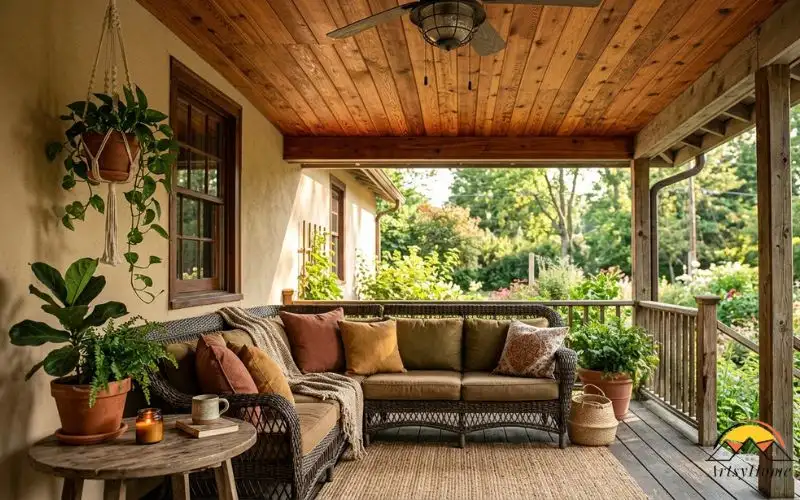
If you’re staining and you live somewhere humid, cedar and cypress are the two I’d trust with my own house. The oils in them fight off rot and bugs on their own, no chemical treatment required. Going the painted route instead? Then kiln-dried pine is the smarter buy. Cheaper, and it soaks up color like it’s thirsty. Whatever you choose, seal every face before it goes up. All four sides. The backs especially. Everybody skips the backs, and everybody pays for it.
I know because I paid for it. Sealed only the show face on my first run of cedar, felt clever, and watched the boards cup as water wormed into the raw backs. Warped inside a few weeks. Lesson bought and paid for.
Tongue-and-groove
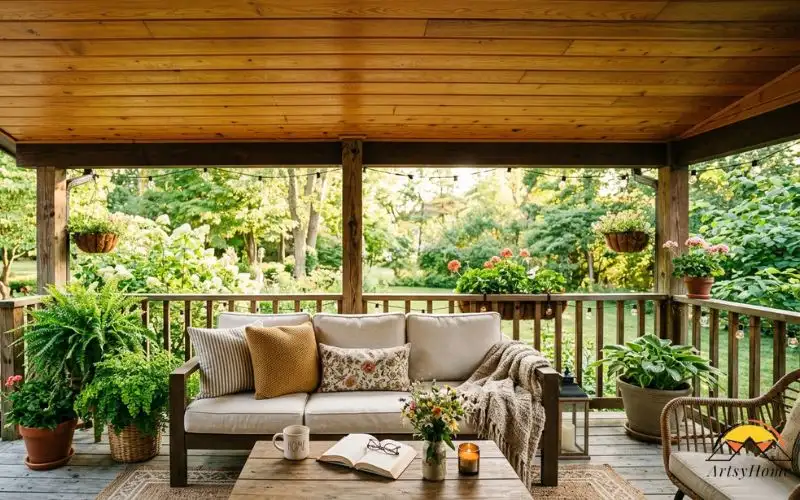
This is the one I’d pick on a desert island, and I’ll happily argue about it. Twelve by sixteen, my porch. I ran 3.5-inch cedar boards across it, left a 1/8-inch gap between each so they’d have room to move with the seasons, and blind-nailed through the tongues with stainless brads so nothing shows.
Every board got two coats of Minwax exterior stain first, front and back, before it ever met the ceiling. Installed properly, real tongue-and-groove lands somewhere between $4 and $10 a square foot, at least per HomeGuide’s 2026 numbers. Pricey, but also worth every dollar.
Beadboard for the cottage look
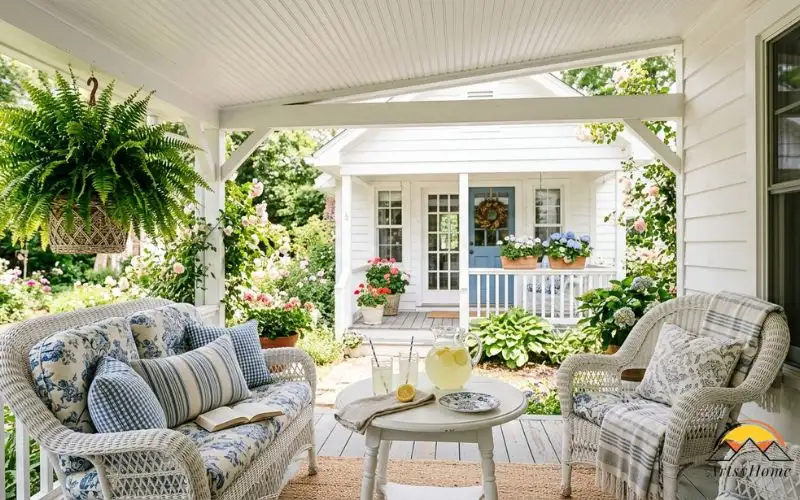
Beadboard is basically tongue-and-groove that dressed up for church, a little rounded ridge running between each plank. You’ll find it two ways. Big 4-by-8 sheets, or single planks. Sheets are quick, I’ll give them that, but the seams have a way of announcing themselves eventually. Planks take real patience and look about a hundred times better for it.
On a porch that really takes a beating from weather, I’d reach for AZEK’s reversible PVC beadboard. Bead on one side, V-groove on the other, your pick. It won’t rot, and it’ll never once ask you for a coat of paint.
Exposed rafters and beams
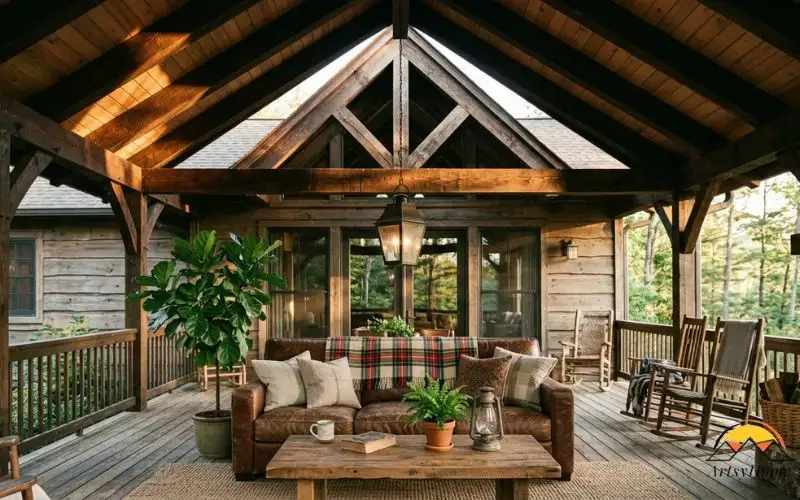
Here’s a move people forget: sometimes the best ceiling is no ceiling. Leave the exposed rafters and bare sheathing showing, and the whole porch takes on this hunting-lodge feel, for zero extra dollars. Framing’s usually 2-by-8 rafters, set two feet apart on center.
The downside shows up every spring, when you’re up on a ladder knocking down wasp nests and cobwebs. Worth it under the right roof, though. On a vaulted porch with a gable overhead, those bare beams give you real drama, and all that hot summer air just climbs up and out of your way.
Plywood on a budget
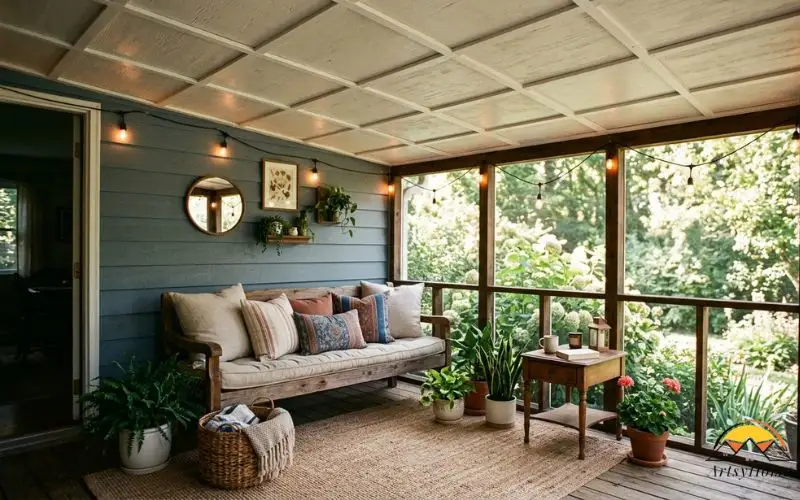
Plain plywood, the exterior-grade stuff, is the true workhorse of a tight budget. Often under two bucks a square foot. Left raw, sure, it looks a little unfinished.
Here’s the fix:
Run thin lath strips over the seams in a tidy grid, and all of a sudden the thing reads deliberate, almost like a coffered panel. Pulled this off on a buddy’s screened porch for less than $200 in materials. Nobody’s guessed it was plywood yet.
Should a low porch and a vaulted porch get the same ceiling?
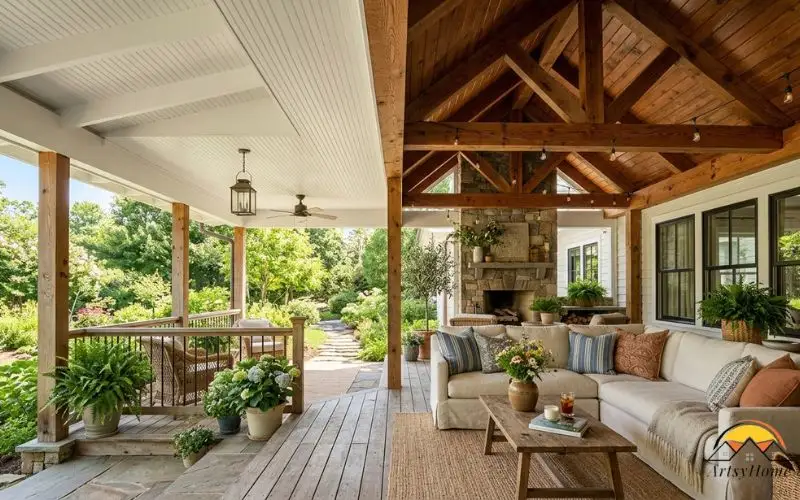
Short answer, no. Got a low or flat porch? Then light and simple is your friend. Bright white beadboard or flat planks lift your eye and keep the space from closing in like a cave.
A tall gable porch is an entirely different opportunity. Room to get ambitious there: stained wood, exposed beams, maybe a two-tone treatment with some real depth.
And don’t overlook the roof shape while you’re at it.
A gable hands you volume, light, and better airflow, but the trade is that blowing rain reaches more of your ceiling. A hip roof shelters more of it, though it’ll sit a touch lower over your head. Personally? I never commit to a finish until I know exactly what roof I’m dealing with.
Cheap porch ceiling ideas that don’t look cheap
The cheapest way to cover a porch ceiling comes down to two contenders: exterior plywood painted with exterior-grade latex paint, or PVC beadboard planks. Figure roughly $1.50 to $3 a square foot for either. And if there’s already a ceiling up there gathering dust? Two coats of exterior paint will freshen it for a few bucks a square foot. That’s the whole secret.
None of that has to look bargain-bin, either. The trick is picking something that hides its price tag, and steering clear of anything so flimsy it bows when you press up on it. That little bow? Dead giveaway.
The budget king, vinyl soffit
Get close to vinyl soffit and yeah, it looks like plastic. Because it is. But the stuff is close to indestructible, it couldn’t care less about humidity, and it goes up in an afternoon. Angi’s 2026 figures peg vinyl around $5 to $9 a linear foot. Aluminum’s a step up, $9 to $17.
Back porch? I’d hang it in a heartbeat and never think twice.
A front porch where folks pause and glance up, that’s where I’d spend a little more. It’s the exact budget-first thinking I lean on over in my cheap patio floor ideas.
What renters can do without losing a deposit?
Renting the place? You’ve still got options that won’t cost you the deposit. A few that leave no lasting marks:
- Peel-and-stick wood planks like Stikwood, which come off cleaner than you’d expect
- A fresh coat of exterior paint over whatever’s already up there
- Removable outdoor curtains or bamboo shades to hide a plain ceiling
The best material for an outdoor porch ceiling (by climate)
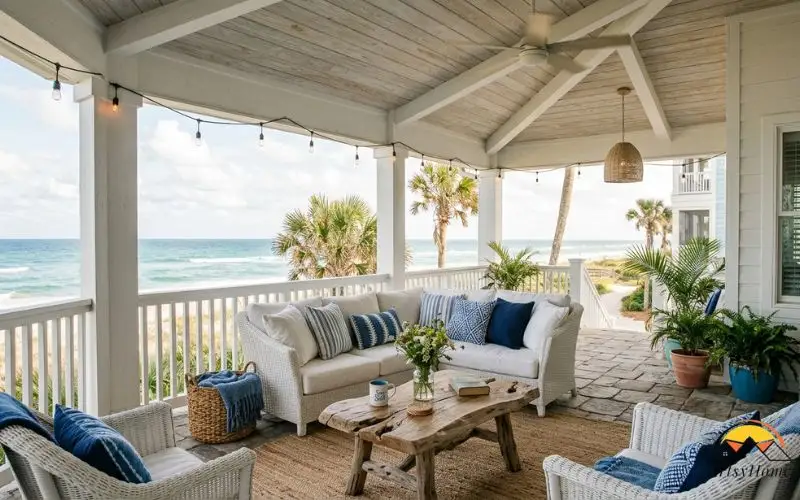
The best material for an outdoor porch ceiling, if I’m being blunt about it, is cellular PVC or fiber cement. Both of them ignore moisture, rot, and bugs for decades and ask for almost nothing back. If you’re set on wood, cedar and cypress are the ones that hold. But here’s the real truth. Your climate decides this, not your Pinterest board.
I once watched a beautiful stained ceiling go gray and splotchy in two coastal summers flat. Two. Sealer simply can’t out-muscle salt air and hard UV working together. So pick for the conditions your porch lives in day to day, not the pretty photo that got you started.
| Climate | What I’d use | Why |
| Coastal, salt air | Cellular PVC or aluminum | Salt and sun destroy wood sealer fast |
| Humid South | Cedar, cypress, or PVC | Rot resistance; pairs with haint blue |
| Wildfire (WUI) zones | Fiber cement or aluminum | Non-combustible, meets Class A fire code |
| Cold, freeze-thaw North | Wood or PVC, not cheap vinyl | Brittle vinyl can crack in deep cold |
Painted porch ceilings and the haint blue bug myth
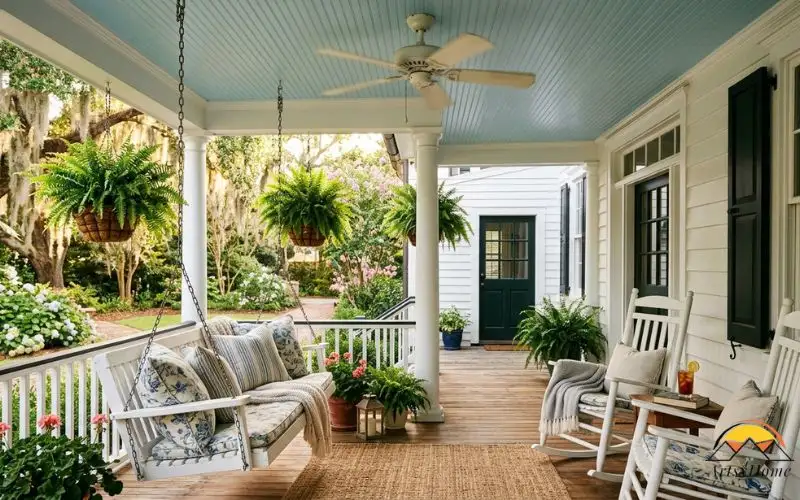
So does a blue porch ceiling really keep the bugs away? Not so much, and I painted mine blue regardless. The bug-repelling story around haint blue really goes back to the lye in old milk-based paints, not the shade of blue itself. Modern paint? No lye in it anywhere. Which means a blue ceiling today is about heritage and looks, not a single mosquito less.
That takes nothing away from the tradition, mind you. It just means you paint the ceiling blue because it moves you, not because some paint-counter legend promised you a wasp-free summer.
Where haint blue really comes from
The custom comes from the Gullah Geechee people, descendants of enslaved Africans who settled the coasts of South Carolina and Georgia. A “haint,” in that older language, is a restless spirit, and the belief went that a haint couldn’t cross water.
So a soft, watery blue overhead was meant to send them drifting right past. Congress went on to recognize the Gullah Geechee Cultural Heritage Corridor in 2006, and it’s a history worth sitting with before this ever becomes just a chip on a fan deck.
The blue paint colors I’d actually use
Do yourself a favor and test swatches on scrap boards, not that useless little chip. Three of them held their own in real daylight for me. Benjamin Moore’s Palladian Blue HC-144 is the soft, safe classic. Sherwin-Williams Rainwashed SW 6211 pulls a hair greener. And Farrow & Ball’s Green Blue is the broodiest of the three by a mile.
Not sold on blue? Plain bright white bounces the most light around and keeps a low porch feeling airy. Want the opposite mood? A matte black ceiling looks knife-sharp set against a black-and-white house exterior, or over deep olive-green siding.
Do you need a wet-rated fan on a covered porch?
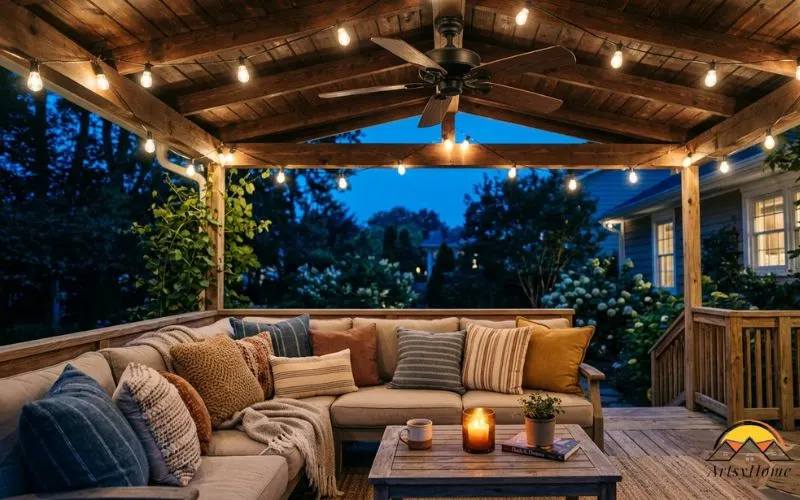
On a covered porch that stays dry when it storms, a damp-rated fan is all you need. It’ll run just as long as a wet-rated one would in that same protected spot. Save the wet-rated gear for places that truly get drenched. Open pergolas. Uncovered decks. Shallow porches where the rain comes in at an angle. And the exact same rule goes for your recessed cans and string lights.
I figured this out the dumb way, by killing a fan. Hung a cheap indoor-rated model to save myself forty bucks. One humid season later, the motor had seized up with rust and the blades sagged like a wilted flower. Swapped in a proper damp-rated one, and it’s spun happily for three years since.
| Where it goes | Rating you need |
| Deep covered porch, screened porch | Damp-rated |
| Shallow cover, coastal, high wind | Wet-rated, to be safe |
| Open pergola, uncovered deck | Wet-rated, required |
What a porch ceiling costs, and whether it pays off
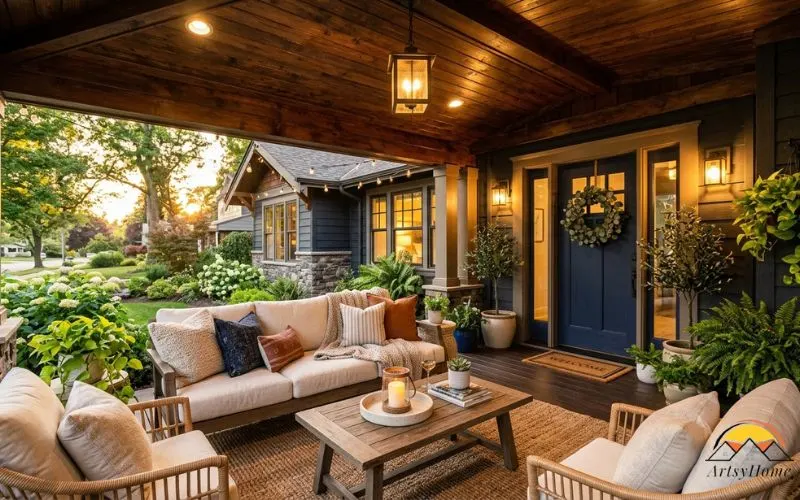
Cost-wise, a finished porch ceiling stretches from about $1.50 a square foot for painted plywood all the way to $10-plus for installed hardwood tongue-and-groove. Does the money come back? The National Association of Realtors found a new patio returns roughly 95% of what you sink into it, with a nearly perfect joy score.
Outdoor living is one of those rare upgrades buyers reward without much arm-twisting, and the appetite for it isn’t cooling off. NAHB data shows 66.4% of single-family homes started in 2022 came with a porch, the biggest share since 2005. A ceiling that makes yours usable all year is part of that same curb-appeal equation, whether you’re selling or settling in for good.
My honest pick for most porches
If I were starting from scratch on a covered porch tomorrow? Cedar tongue-and-groove, every side sealed first, and a damp-rated fan overhead. On a back porch running tight on cash, PVC beadboard, and I’d lose zero sleep over it.
Match the ceiling to your climate, never to a mood board. Do that one thing, and you’ll outlast every trend that comes and goes.

