
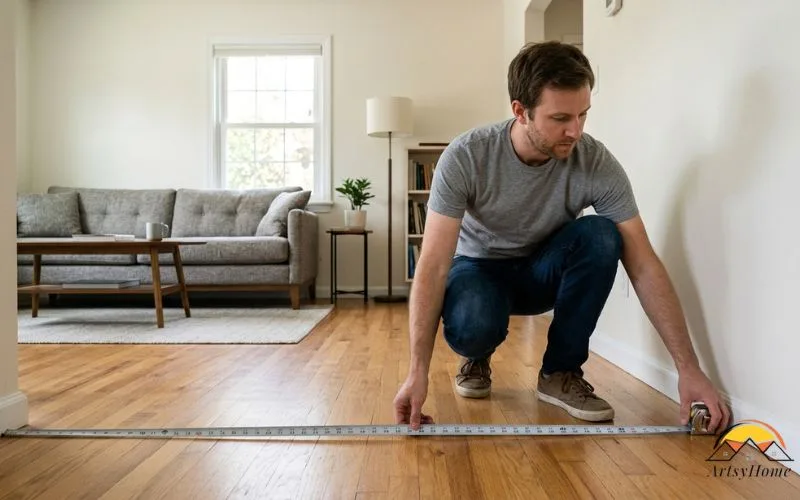
Working out how many square foot a room has sounds like it should need a calculator and a diagram, but it really comes down to one step. Multiply the length by the width, both in feet, and whatever number you get is your square footage. That’s why the 12 by 12 bedroom on a listing is 144 square feet. The one that catches people is the 10 by 10, which is 100, not 1,000, and that mix-up trips up more people than you’d think. (Properly, it’s “square feet,” by the way, though plenty of us type “square foot” into Google.)
Below you’ll find the answers for the sizes people look up most, what a typical bedroom, garage, apartment or house actually measures, and a few handy conversions like square yards and acres. For your own room, our square footage calculator does the math in a few seconds.
Table of Contents
Sizes People Ask About Most
Here’s the quick version for the sizes people ask about most. We lined each one up against the national averages further down, because knowing a room is 144 square feet doesn’t tell you much until you know whether that’s big or small for a bedroom
| Room size (feet) | Square feet | How it compares |
| 10 x 10 | 100 | Low end of the 100 to 150 kids’ room range (Angi) |
| 10 x 12 | 120 | Typical guest bedroom (This Old House) |
| 12 x 12 | 144 | A little above the 132 sq ft average bedroom (Angi) |
| 10 x 15 | 150 | Top of the kids’ room range (Angi) |
| 12 x 18 | 216 | Standard living room (Angi) |
| 12 x 20 | 240 | Average one-car garage (Angi) |
| 15 x 20 | 300 | Upper half of the 130 to 420 living room range (Angi) |
| 18 x 18 | 324 | Also in the upper half of that living room range |
| 18 x 20 | 360 | Average two-car garage (Angi) |
| 20 x 20 | 400 | Near the top of the living room range, and 40 sq ft more than an average two-car garage |
One heads-up about listings and floor plans: the sizes on them are nearly always rounded. That “12×12” bedroom might really be 12 feet 6 inches by 12 feet, which is 150 square feet instead of 144. Not a big deal for picturing the room, but if you’re ordering flooring, measure it yourself first.
Why a 10×10 Room Isn’t 1,000 Square Feet
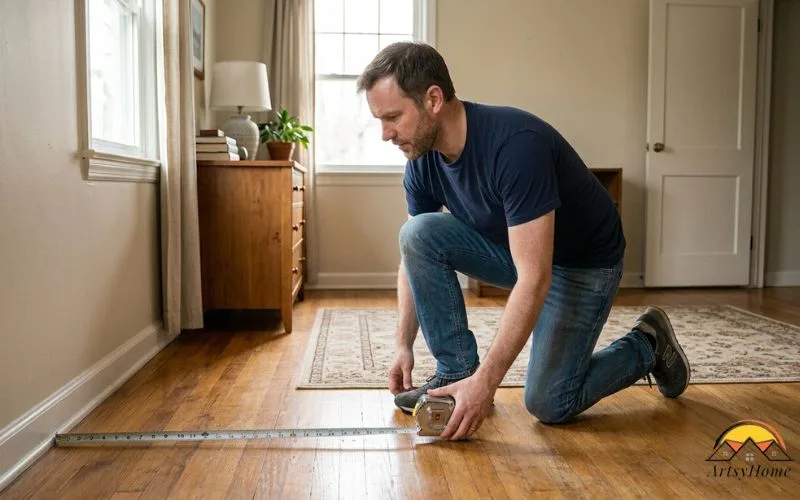
This mix-up is behind a lot of the questions people type into Google, so it’s worth a minute. A wall that’s 10 feet long is a line. Square feet describe a surface, and a surface needs two measurements multiplied together, which is how 10 by 10 gets you 100. If you came out with 1,000, there’s probably a stray zero in there somewhere, or you were picturing a space 10 by 100.
It’s also why nobody can give you a straight answer to “how many square feet are in a foot.” A strip that’s 1 foot long covers 1 square foot if it’s a foot wide, but 12 square feet if it’s 12 feet wide, so without the width there’s nothing to go on. The same slip explains the question of whether a 12×12 room is 24 square feet. Add 12 and 12 and sure, you get 24, but area comes from multiplying, and that gives you 144.
Tip: Walk the edge of a 12×12 room and you’ve covered 48 feet. That’s your number for baseboard or trim. The floor is still 144 square feet, and ordering trim by square footage (or flooring by the perimeter) is an easy mistake that costs real money.
Picturing 1, 30, 200 and 1,000 Square Feet
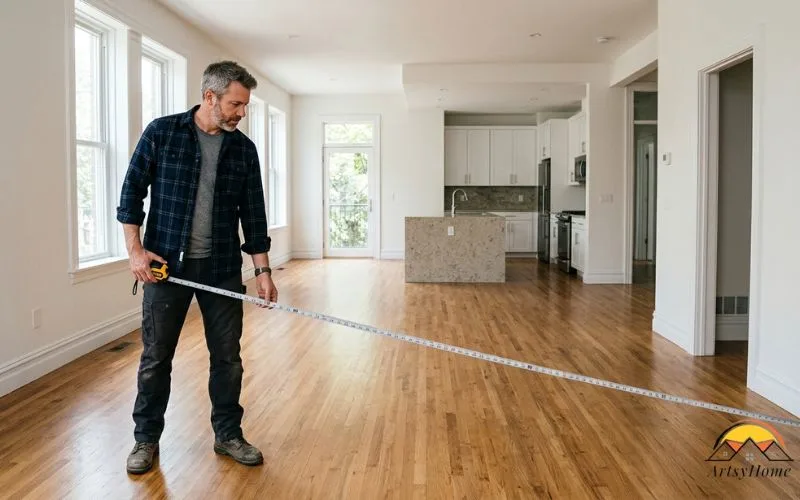
A single square foot is smaller than most of us picture. It’s just a square 12 inches on each side, about the size of one of those standard 12 by 12 floor tiles you see in kitchens.
Thirty square feet isn’t much at all, maybe 5 by 6 feet, so think area rug, not room. Two hundred is where it starts feeling like a real room, something like 10 by 20 or close to 14 by 14. That’s a good deal roomier than the average U.S. bedroom, which Angi puts at around 132 square feet.
And a thousand square feet? Lay it out as 25 by 40, or 20 by 50, or make it a square roughly 31.6 feet on each side. It’s a touch smaller than a new two-bedroom apartment, which averages 1,095 square feet in RentCafe’s 2026 figures, so if you’ve ever lived in a newer two-bed, you already have a decent feel for it.
Is Your Room Small, Average or Big?
So is your bedroom small? Could be, but check it against the averages before you decide. The average U.S. bedroom is about 132 square feet, which is roughly an 11-by-12-foot room. A standard living room comes in at 216, and the average bathroom is a tight 40 or so. Those are national averages, mind you, so yours landing a bit above or below is completely normal. The table has the rest.
| Space | Typical size (square feet) |
| Average bedroom | about 132 |
| Primary bedroom | 200 to 400 |
| Kids’ room or nursery | 100 to 150 |
| Guest bedroom | about 120 (10 x 12) |
| Living room | 216 standard (most fall between 130 and 420) |
| Kitchen | 150 to 250 |
| Bathroom | about 40 |
| One-car garage | 240 (12 x 20) |
| Two-car garage | 360 (18 x 20) |
| Three-car garage | 704 (32 x 22) |
Then there’s the question of whether a small room can legally be called a bedroom at all. The rule you’ll bump into is section R304 of the International Residential Code, which a lot of U.S. states and cities adopt. Every habitable room, bedrooms included, needs at least 70 square feet, with no side under 7 feet. Local versions do differ, though. So if a listing is passing off a tiny office as a third bedroom, a quick call to the building department will settle it.
Garages are a funny one. Angi’s 360 square feet is only the average for a two-car garage, and yours could easily be a fair bit bigger or tighter than that once a car is actually parked in it. If a workbench or a second fridge is on the wish list, measure first.
What Apartments and Houses Usually Measure
If you’re renting, a new U.S. apartment averages about 910 square feet in RentCafe’s 2026 numbers. If you’re buying, the median new single-family home finished in 2025 was 2,142 square feet, per the U.S. Census Bureau, which is a bit more than two of those apartments put together. Here’s how apartment sizes break down by type.
| Apartment type | Average size (square feet) |
| Studio | 460 |
| One bedroom | 735 |
| Two bedroom | 1,095 |
| Three bedroom | 1,355 |
One catch with those apartment numbers: they come from newer buildings, and older places can run smaller. The house figure is only new homes too, not everything for sale. And when you’re comparing listings, remember that listed square footage normally covers finished living space only, so the garage and any unfinished basement aren’t counted. If you want the details of how appraisers measure a house, our guide on how do you get the square foot has them.
Square Yards, Square Meters and Acres
Honestly, you’ll only need most of these now and then, but it’s nice having them in one spot. A square yard is 9 square feet, which clicks once you picture it as 3 feet by 3 feet. A square meter is a little over 10 square feet, about 10.764, going by NIST’s exact definition of a square foot as 0.09290304 square meters. And an acre? That’s 43,560 square feet, the number in NIST’s acre conversion table, or about the size of a square 209 feet on each side.
| Unit | Square feet |
| 1 square foot | 144 square inches |
| 1 square yard | 9 square feet |
| 1 square meter | about 10.764 square feet |
| 1 acre | 43,560 square feet |
The 144 thing confuses a lot of people, but it’s simple once you see it. A square foot is 12 inches by 12 inches, and 12 times 12 is 144. So a rug you’ve measured at 60 by 30 inches covers 1,800 square inches, and dividing by 144 turns that into 12.5 square feet. There’s more on that in our piece on how many inches are in a square foot.
What a Gallon of Paint or a Box of Flooring Covers
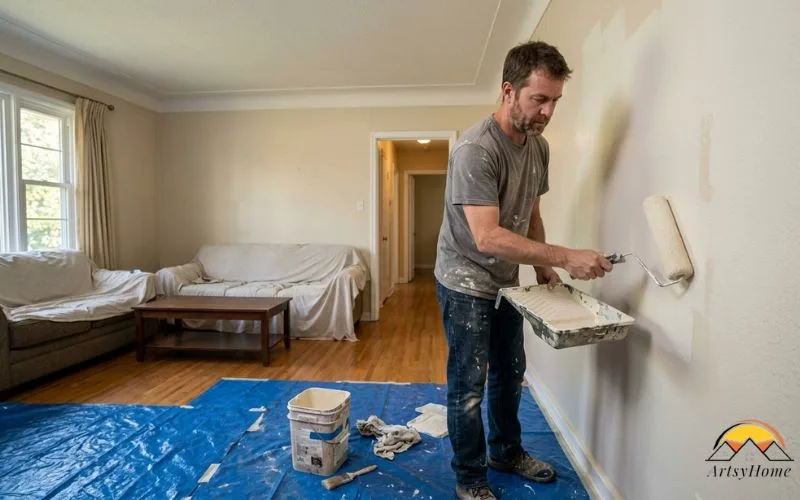
Paint is where square footage gets a little sneaky. A gallon covers about 350 to 400 square feet and a quart around 100, but that’s wall area you’re covering, not floor area.
Say you’re painting a 10×10 room with 8 foot ceilings. The floor is only 100 square feet, but the four walls add up to about 320, so one gallon gets you roughly one coat. Going for two coats? We’d grab two gallons rather than risk running short halfway around the room.
Flooring’s the same story, just with boxes instead of cans. Every carton has its coverage printed on the side, so divide your room’s square footage by that number and round up to the next whole box. For how much extra to add for cuts, our guide to what a square foot means in flooring goes through it.
How to Find Square Feet for Your Own Room
For your own room, the idea doesn’t change: length times width in feet, and if the room zigzags, split it into rectangles and add them up. Inches on the tape? Divide them by 12 first, so 12 feet 6 inches becomes 12.5. Just pop your numbers into the square footage calculator.
A Few More Questions People Ask
How many square feet is 30×40 or 30×50?
It’s 1,200 square feet for 30×40, and 1,500 for 30×50. To get a feel for the smaller one, picture three average two-car garages side by side (360 square feet each, per Angi, 2026). You’d still come up a little short. At that size, being a few inches off on each side adds up quickly, so take care if you’re pricing materials.
How many square yards is a 12×12 room?
Sixteen. The room is 144 square feet and a square yard holds 9, so 144 divided by 9 gets you there. Worth knowing, since carpet still gets priced by the square yard sometimes, and you’ll want a little extra on top for seams and waste.
Does square footage include closets and hallways?
Usually, yes. Closets and hallways inside the finished living space count toward a home’s listed square footage, and you’d include them for flooring too, since they’re getting the new floor as well. What normally gets left off a listing is the garage and any unfinished space.
How accurate is the square footage on a listing?
Close, but we wouldn’t treat it as exact. Listed figures are often rounded and people don’t all measure the same way, so two listings can describe the same space a little differently. If you’re about to buy flooring, paint, or furniture off that number, measure the room yourself first.
Before You Buy Anything
So whatever you’re sizing up, it really does come down to length times width in feet, and yes, a 10×10 is 100, not 1,000. If a room or listing doesn’t quite line up with the tables here, measure it yourself and run the numbers through our square footage calculator before you spend money on flooring, paint or furniture.