
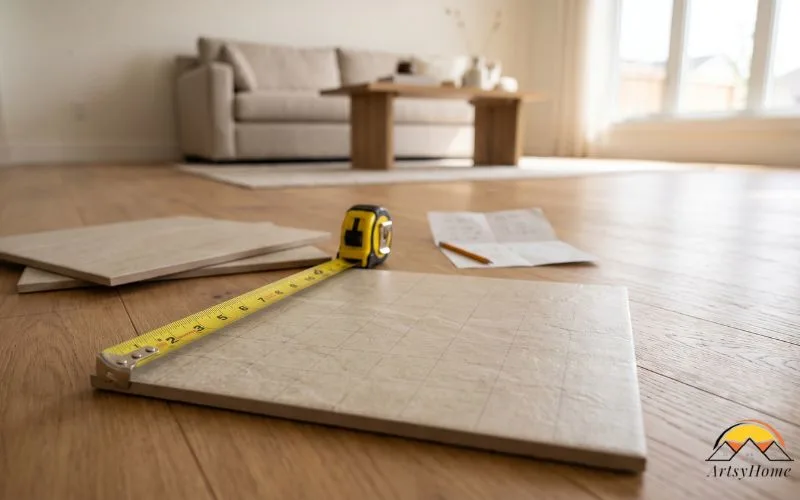
Short answer: 144 square inches fit in a square foot. We call it kitchen-table math because that’s about all it takes. Each side of a square foot runs 12 inches, and 12 times 12 is 144.
So you’ve measured in inches, and the tile (or flooring, or whatever you’re eyeing) is sold by the square foot. Multiply length by width with both still in inches, divide the total by 144, and that’s your square footage. What if a room measures 11 feet 7 inches? We’d honestly punch it into the square footage calculator and let that handle the arithmetic.
Table of Contents
Understanding Square Inches vs. Inches
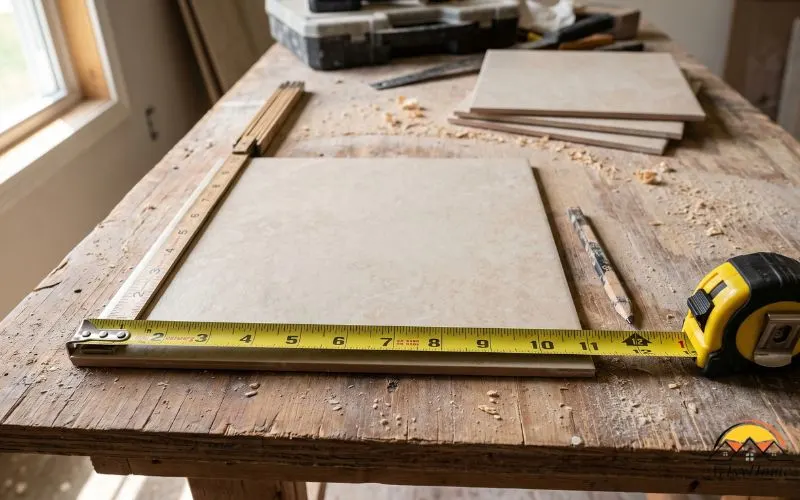
144 square inches, on the dot. Nobody rounded anything off to get there, and nobody needs to.
Picture a plain 12-inch floor tile and pencil a grid onto it, twelve little squares across by twelve down. Count them all, if you’ve got the patience for it (we sure wouldn’t), and you’ll hit 144.
1 sq ft = 12 in × 12 in = 144 sq in
Here’s the part that muddles people. An inch measures length, a distance along a line; a square inch measures area, a tiny patch of surface. So a square foot isn’t “144 inches,” strictly speaking. Its edges are 12 inches apiece, and the surface they fence in adds up to 144 square inches.
Funny thing, too: it doesn’t have to be square at all. Take a long skinny strip, 6 inches by 24. That’s 144 square inches, which makes it a perfectly legit square foot that just happens to look like a ruler.
How to Convert Inches to Square Feet
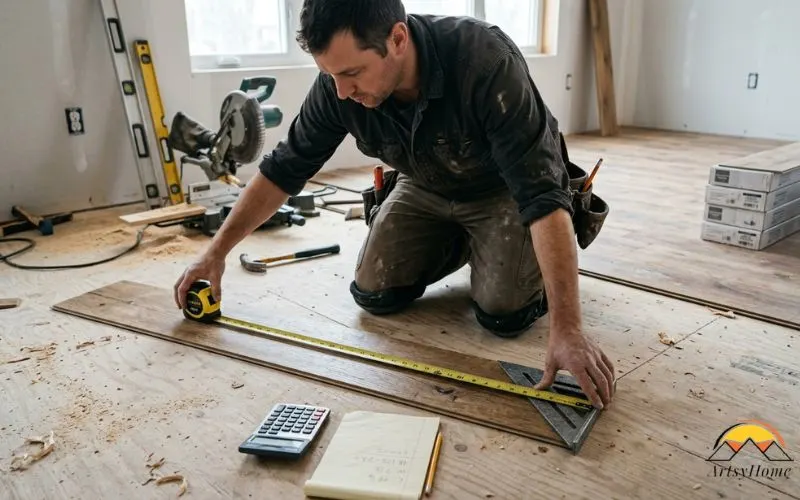
Two measurements. One multiplication, one division. Honestly, that’s the whole trick.
Square feet = (length in inches × width in inches) ÷ 144
- Measure the length in inches.
- Measure the width, in inches too (no sneaking feet in here).
- Multiply them, which gives you square inches.
- Divide by 144, and now you’ve got square feet.
Formulas are easier to trust once you’ve watched them chew through some real stuff:
- A 6 × 9 inch photo print: 54 square inches, or 0.375 square feet
- The 24 × 36 rug by the back door: 864 square inches, so six square feet flat
- A backsplash that runs 90 inches along the counter and climbs 18 inches up the wall: 1,620 square inches, which is 11.25 square feet of tile (not counting the extra you’ll want for cuts)
Some people prefer converting each side to feet first, dividing by 12, and then multiplying. That works fine and lands on the same answer. Our gripe with it is the rounding it drags in halfway through, which is why we’d rather stay in inches and convert once, right at the end. Oddly shaped room? Break it into rectangles on the back of an envelope, work out each chunk, then add them up.
How to Convert Between Square Inches and Square Feet
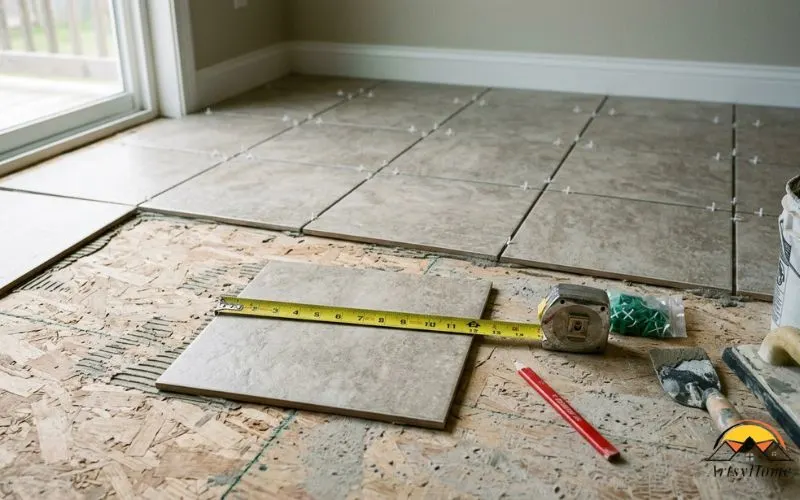
Already sitting on a number in square inches? Divide it by 144. Going the other way, square feet back to square inches, you multiply by 144.
- 720 square inches ÷ 144 = 5 square feet
- 2 square feet comes to 288 square inches
- 10 square feet is 1,440 square inches
You’ll bump into this constantly with wallpaper, shelf liner and flooring, since the box speaks square feet while your tape measure speaks inches. And that 144 isn’t some rough estimate.
The US inch was locked at exactly 25.4 millimeters back in 1959 (Federal Register, 1959), so the number holds up to whatever decimal place you throw at it.
How to use tape measure fractions
Tape measures hardly ever hand you a neat round number. Most standard US tapes get marked down to sixteenths of an inch, and each of those little ticks has to turn into a decimal before any multiplying starts.
| Fraction | Decimal | Fraction | Decimal |
| 1/16 | 0.0625 | 9/16 | 0.5625 |
| 1/8 | 0.125 | 5/8 | 0.625 |
| 3/16 | 0.1875 | 11/16 | 0.6875 |
| 1/4 | 0.25 | 3/4 | 0.75 |
| 5/16 | 0.3125 | 13/16 | 0.8125 |
| 3/8 | 0.375 | 7/8 | 0.875 |
| 7/16 | 0.4375 | 15/16 | 0.9375 |
| 1/2 | 0.5 |
Let’s say the shelf you’re lining measures 35 3/4 by 23 1/8 inches. That becomes 35.75 times 23.125, or 826.72 square inches, and once you divide by 144, you’re sitting at 5.74 square feet.
Rounding both sides up to 36 and 24 is tempting because it’s quick. We think it’s sloppy, though. You’d get 6.0 square feet, roughly 4.5% more than what’s really there, and on stone or hardwood that little gap turns into actual dollars. Keep the exact figures, then add your waste allowance at the end, on purpose.
Common Mistake: Dividing by 12 Instead of 144
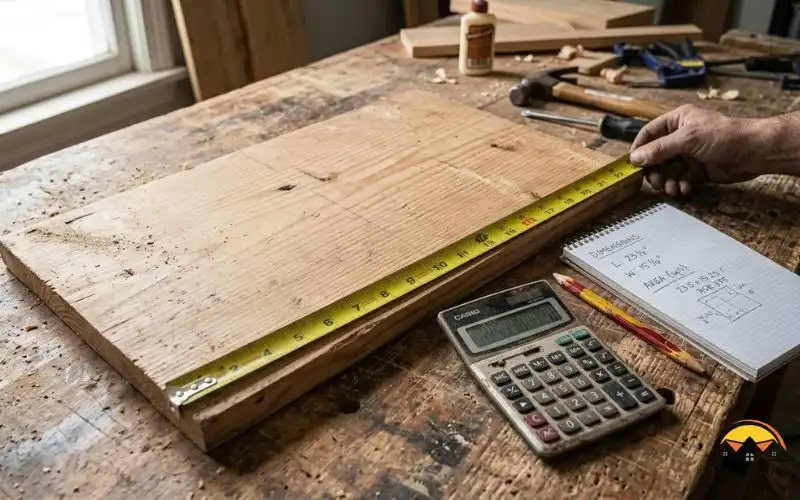
If we had to pick the single most common slip, it’s this one. Someone figures out their square inches, divides by 12 on autopilot, and walks off with an answer twelve times too big.
It happens so often that Illustrative Mathematics built a grade 6 lesson around it. Their example board is 60 inches by 48, so 2,880 square inches. Divide by 12 and you’d swear it’s 240 square feet. Divide by 144 instead and you get 20, which is right.
Why does it happen? Dividing by 12 converts just one side, but area has two sides, so you’ve got to divide by 12 twice. Twelve twelves, 144.
Our favorite gut check is asking whether the answer passes the sniff test. A board 5 feet by 4 feet can’t cover 240 square feet; that’s more or less the floor of a roomy bedroom.
Inches to Square Feet Chart
A handful of sizes that come up over and over with tile, frames, prints and rugs, math already done:
| Size (inches) | Square inches | Square feet | Common use |
| 6 × 9 | 54 | 0.375 | Photo print |
| 8 × 10 | 80 | 0.56 | Picture frame |
| 12 × 12 | 144 | 1 | Floor tile |
| 12 × 24 | 288 | 2 | Large-format tile |
| 16 × 20 | 320 | 2.22 | Canvas print |
| 18 × 18 | 324 | 2.25 | Porcelain tile |
| 24 × 24 | 576 | 4 | Stone tile |
| 24 × 36 | 864 | 6 | Small area rug |
| 36 × 60 | 2,160 | 15 | Entry rug |
Square Foot and Square Inch in Metric
Ordering from a metric tile catalog? One square foot is exactly 929.0304 square centimeters (0.09290304 square meters, if you prefer), and a single square inch is exactly 6.4516 square centimeters (NIST Guide to the SI). For a ballpark, NIST’s own conversion card just rounds a square foot to 0.09 square meters (NIST conversion card).
Packaging usually shortens these to sq ft or ft², and sq in or in².
Frequently Asked Questions
How many square inches are in a square yard?
1,296 of them. A yard is 36 inches, and 36 × 36 gets you to 1,296, the same as 9 square feet. Carpet gets quoted in square yards a lot, so this one’s worth keeping in your back pocket.
How many cubic inches are in a square foot?
Kind of a trick question. Square feet measure flat surface, cubic inches measure volume, and you can’t hop from one to the other without a depth. If it helps, a full cubic foot holds 1,728 cubic inches
Is 100 square inches a square foot?
Nope, not quite. 100 divided by 144 is about 0.69, so 100 square inches is a shade over two thirds of a square foot. You’d need 44 more to fill one out.
How do I find square feet if one side is in feet and one is in inches?
Get everything into inches before you multiply. A shelf run 10 feet long and 18 inches deep becomes 120 × 18, or 2,160 square inches, and dividing by 144 leaves 15 square feet. Multiply feet by inches straight across and you’ll get a number that means nothing at all.