
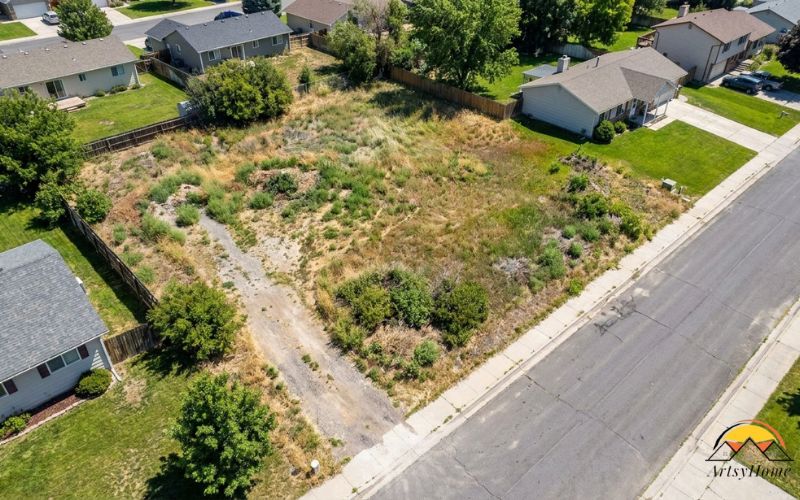
Anywhere from a few cents to about $12 a square foot, going by 2026 prices. Farmland sits at the cheap end and city lots at the top, and where a piece of land is (plus what the zoning lets you build on it) decides most of the rest.
You’ll rarely see land priced like that, though. Farms get sold by the acre and house lots usually carry one price for the whole thing, so you have to do a bit of division to get a per-square-foot number. There are 43,560 square feet in an acre. Land at $75,000 an acre comes to about $1.72 a square foot.
Table of Contents
Average Price of Land Per Square Foot in 2026
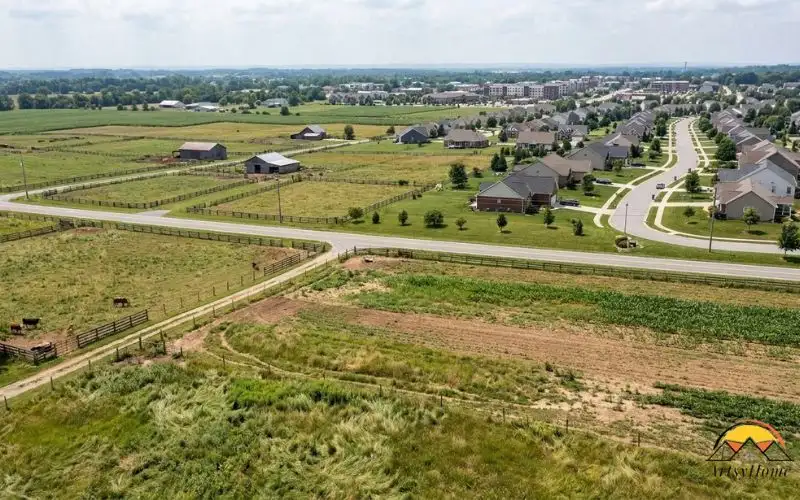
Here’s what each type of land is going for right now, per acre and per square foot.
| Type of land | Price per acre | Price per sq ft |
| Pasture (U.S. average) | $2,000 | about $0.05 |
| Farm real estate (land plus farm buildings) | $4,500 | about $0.10 |
| Cropland (U.S. average) | $6,020 | about $0.14 |
| Rural vacant lot | about $75,000 | about $1.72 |
| Suburban vacant lot | over $181,000 | about $4.16+ |
| Urban vacant lot | about $500,000 | about $11.48 |
Farmland is cheap. Really cheap. An average acre of U.S. farm real estate is worth $4,500 this year, around a dime a square foot, and pasture is about half that. It sells in big chunks, usually well out of town, and whoever buys a quarter section of corn ground isn’t paying for streets or sewer lines or a building permit.
Building lots are another matter. Before a lot is ready for a house, someone has paid to get it zoned, cut a road to it and bring in water, sewer and power, and the seller wants that money back. So a vacant rural lot ends up around $1.72 a square foot, roughly 17 times what farmland goes for, and a suburban one runs over $4.
Cities top the chart at about $11.48 a square foot, and some coastal cities go way past that. New-home lots in the Pacific states have the highest median value anywhere, $171,000, and half of them are under 0.13 acres, which tells you plenty about what land costs out there.
Tip: Before you do any of this math, look up the county assessor’s record or the recorded plat for the lot’s real size. Listings round up. “About half an acre” can turn out to be 0.42.
Land Prices by State
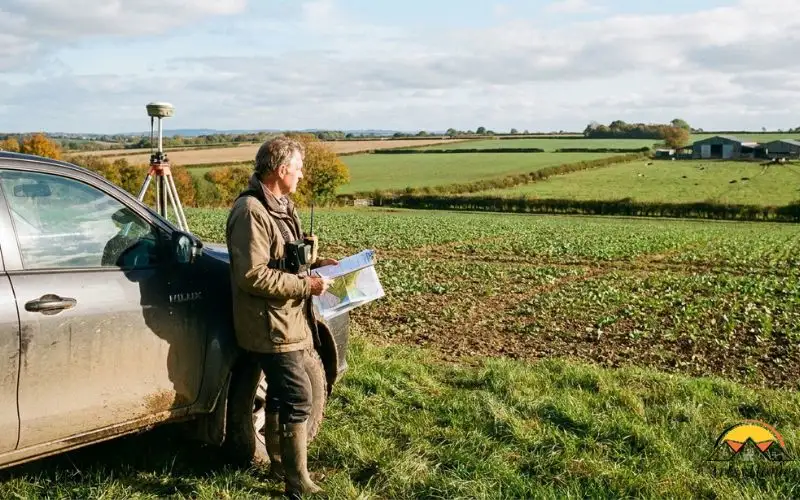
Farmland shows the spread between states nicely, since every state measures it the same way. Rhode Island farm real estate averages $23,600 an acre, about 54 cents a square foot. New Mexico? $735 an acre, under 2 cents.
| State | Farm real estate per acre | Price per sq ft |
| Rhode Island | $23,600 | about $0.54 |
| New Jersey | $17,000 | about $0.39 |
| U.S. average | $4,500 | about $0.10 |
| Wyoming | $1,030 | about $0.02 |
| New Mexico | $735 | under $0.02 |
The pattern is pretty simple. Small, crowded states near big cities sit at the top because farms there are competing with housing for the same ground, and the big dry states out West sit at the bottom with lots of open range and not many people wanting it.
Why Some Land Costs So Much More
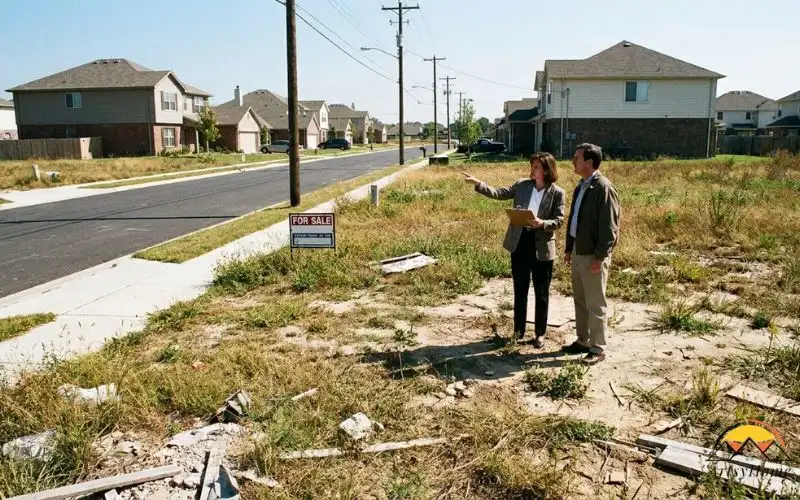
Location is most of it. Land near jobs, decent schools and main roads costs more pretty much everywhere, and a similar parcel half an hour further out might go for a fraction of that.
Zoning is the other big one. If the county has zoned a parcel for homes or shops, you can build on it straight away, and buyers pay a good deal more for that than for farm-zoned land. You can usually apply to rezone, but expect public hearings, fees, months of waiting and maybe a no at the end of it.
On raw land, road access and utilities count for a lot. If there’s a paved road out front and power, water and sewer already at the property line, you pay for that in the price. If there isn’t, you pay for it later, in a well, a septic system and a power line.
Bigger parcels usually cost less per acre than small ones nearby, which surprises people. Fewer buyers can afford the big tract, so sellers drop the rate to get it sold. It’s the reason we’d only compare prices between parcels of about the same size.
Keep in mind, too, that some of what you’re buying may not be usable. Steep slopes, wetlands, flood zones, easements, setbacks. They all shrink the buildable part of a lot while still counting toward the acreage on the price tag.
Working Out the Price Per Square Foot Yourself
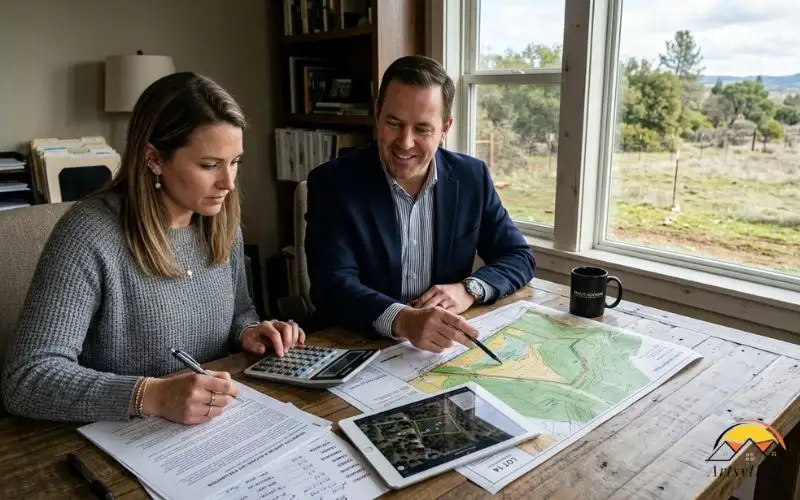
Got a size in acres? Multiply it by 43,560 for square feet, then divide the price by that. A three-quarter-acre lot listed at $90,000, for instance, has 32,670 square feet, so it’s going for about $2.75 a square foot. That’s under the suburban average, and we’d want to know why before getting excited. Could be a slow market. Could also be no sewer hookup, or a drainage problem.
If the seller quotes per square foot, flip it around and multiply by 43,560 to get the per-acre price. Three dollars a square foot works out to $130,680 an acre.
One thing not to do is compare that number with house prices per square foot. A house’s price per square foot is worked out from the floor space inside and it includes the building, so of course it’s way higher than the dirt underneath. Our guide to price per square foot goes into how that works for homes and rentals.
Most lots aren’t neat rectangles either. If all you’ve got is side lengths in feet, break the shape into rectangles and triangles, work each one out and add them up. Our square footage calculator does the math on each piece, same as when you’re measuring a room.
How Big is an Acre?
An acre is 43,560 square feet. Make it a square and each side is about 208.7 feet. But it doesn’t have to be square; any shape counts as long as the area adds up. Picture an American football field, end zones and all, and an acre is roughly three quarters of it.
| Size | Square feet | Side of a square |
| 1 acre | 43,560 | about 208.7 ft |
| Half acre | 21,780 | about 147.6 ft |
| Quarter acre | 10,890 | about 104.4 ft |
| One-fifth acre | 8,712 | about 93.3 ft |
| Typical new-home lot (2025) | 8,543 | about 92.4 ft |
A 200 by 200 foot lot isn’t an acre, even though it sounds like one. It’s 40,000 square feet, about 0.92 of an acre. The typical new U.S. house sits on about 8,543 square feet, a bit under a fifth of an acre, so five of those lots would fit in an acre on paper. Fewer in practice, once roads and sidewalks go in.
What You Will Pay on Top of the Land
And the price of the land isn’t the end of it. Raw land nearly always needs a survey, some utilities and a bit of site work before anything gets built. Rough national costs right now:
| Cost | Typical 2026 range |
| Land survey (1 acre) | $1,500 to $3,500 |
| Well drilling | $5,000 to $10,000 |
| Septic system | $3,400 to $11,500 |
| Electric hookup | $750 to $1,500 |
| City water hookup | $1,000 to $6,000 |
| City sewer hookup | $1,500 to $5,700 |
| Clearing the land | $1,400 to $6,200 |
| Full site development | $25,000 to $50,000 on average |
Site work is the budget killer. Put $40,000 into getting a half-acre ready and you’ve added close to $2 a square foot, more than the land itself cost at the rural average.
Before buying raw land, we’d get a perc test done. That’s the test that shows whether the soil drains well enough for a septic system. Fail it and you may need a much pricier system, or you might not be able to build at all. Get a boundary survey too. It shows exactly where the lines are, and whether the acreage you’re paying for is really there.
Tip: Before making an offer, ring the county planning or zoning office and ask what it would take to get a building permit on that parcel. It’s free, and it can save you from buying land you can’t build on.
How much is 1 acre of land?
It depends on what kind. Farmland averages $4,500 an acre in 2026. A vacant rural lot is more like $75,000 an acre, suburban lots go over $181,000 and urban lots get close to $500,000. The size doesn’t change, though. It’s always 43,560 square feet.
How much is half an acre of land?
Half an acre is 21,780 square feet. Going by 2026 averages, you’d pay about $2,250 for it as farmland, around $37,500 as a rural building lot and over $90,000 in the suburbs.
Is 1 acre a lot of land?
For a house, definitely. It’s about five times a typical new-home lot, enough for the house, a big yard, a garden and a shed with room to spare. As a farm it’s tiny.
How many lots are in an acre?
On paper, about five typical new-home lots fit in an acre. You’ll get fewer in a real subdivision because roads, sidewalks and drainage use up some of the land, and local zoning sets how small a lot can be.
Why is land priced by the acre instead of by the square foot?
Habit, mostly. Plus the numbers read better. Nobody wants to see farmland listed at 10 cents a square foot when $4,500 an acre says the same thing. Small city lots are the exception, since the price per foot there is high enough to be worth quoting.
Is It a Good Price?
So a square foot of land might cost you 2 cents, or it might cost over $11. On its own, that number doesn’t say much. Work out the price per square foot for every listing you look at, check it against similar-sized parcels nearby, then add the survey, utilities and site work before you call it a deal. And when you need to measure the lot itself, our square footage calculator does the math.