
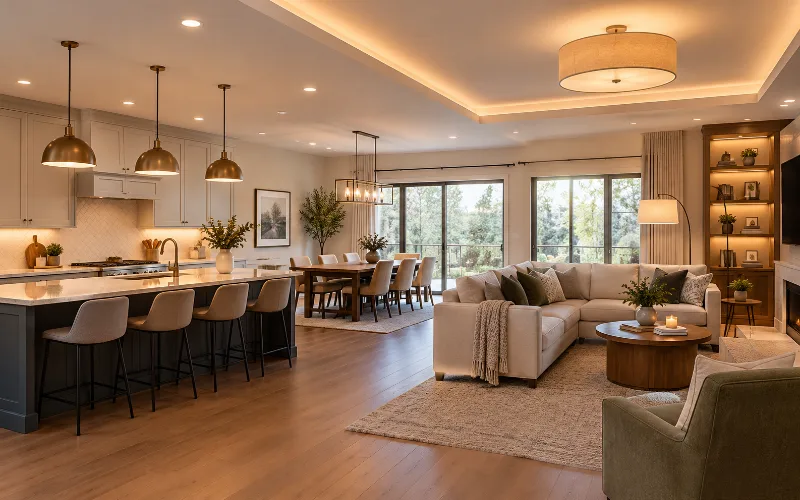
This article discusses practical strategies and expert advice for choosing flexible lighting solutions to suit the distinct zones within open plan living spaces, including options such as designer pendant lights and guidance on layered illumination.
Open plan living spaces require lighting that adapts to a variety of uses, since kitchen, dining, and lounging or reading zones often coexist in a single large room.
Each area benefits from tailored illumination to support activities such as cooking, relaxing, or socializing. Issues like uneven brightness, glare, or insufficiently focused lighting can quickly reduce both comfort and style. To achieve both function and atmosphere, features such as designer pendant lights for kitchens and dining spaces are often selected to help define zones and enhance usability throughout the day.
Table of Contents
Set clear goals for each zone
Begin by determining the main function of each area in your open plan space. Kitchens benefit most from bright, task-focused lighting above worktops for safe meal preparation. Dining zones are often enhanced by softer, warmer light that fosters conversation, while lounge areas require a layered approach so activities like reading or entertaining can each be supported. Transitional spaces, such as walkways, should remain well-lit without overwhelming adjacent zones.
Select lighting that reflects these needs and adapts to shifts in daylight. For example, you may want vibrant light for morning cooking and the ability to lower brightness in the evening when hosting guests.
Layering to achieve flexibility
Flexible lighting in open plan rooms is achieved by layering various sources. Ambient lighting, like recessed ceiling fixtures, maintains an even base level of brightness. Task lights, such as under-cabinet strips in the kitchen or reading lamps in lounging areas, supply illumination where detailed work or comfort is required.
Accent lighting adds visual interest by highlighting architectural elements or decorative features, preventing the space from becoming overly flat or harshly lit. Wall lights or table lamps can be carefully placed to create focal points and soften the overall effect.
Fixtures and finishes for connected areas
Larger, open rooms often suit bigger fixtures, but the scale should be in harmony with ceiling height and space dimensions. With open sightlines, it is important to select fixtures that have a visual relationship without being too uniform. For instance, coordinating metallic finishes across pendant and wall lights while mixing shapes or including glass elements can maintain interest and coherence.
Carefully space lighting such as pendants and recessed fittings to ensure even coverage and avoid unwanted shadows or bright spots. In spaces with higher ceilings, adjustable pendant drops or modular systems can help position light at the right height for each activity.
Smart controls and adaptable circuits
The most effective open plan lighting allows for different areas to be controlled independently. Install dimmer switches and multi-circuit control panels so zones can transition easily between energizing and practical during the day, to soft and ambient for the evening.
Segmenting lighting circuits—for example, dimming the lounge while the kitchen remains bright—ensures no single area overwhelms the whole space, supporting both utility and comfort regardless of activity.
Placement, comfort, and lighting expertise
To maintain comfort, choose lighting with suitable beam distribution to reduce glare and harsh shadows. Ensure all fixtures use a consistent color temperature to prevent visual clashes and maintain a cohesive look.
Consulting lighting specialists can help make these choices easier. Brands such as Visual Comfort design and curate premium decorative and architectural lighting that blends timeless design, craftsmanship, and performance for residential and commercial spaces. Their collections offer coordinated looks and a selection of fixture types, making it simpler to address practical needs without compromising the overall aesthetic.
Key ingredients for a flexible plan
To create an adaptable open plan lighting scheme, prioritize clear zoning, thoughtful layering of ambient, task, and accent lights, and proportionate fixture selection. Add flexible controls so lighting can support different activities and moods. With a well-considered design, your open plan space can stay both functional and visually harmonious even as needs or arrangements evolve.
Read Next: Modern Lighting With Minimalist Lighting Styles