
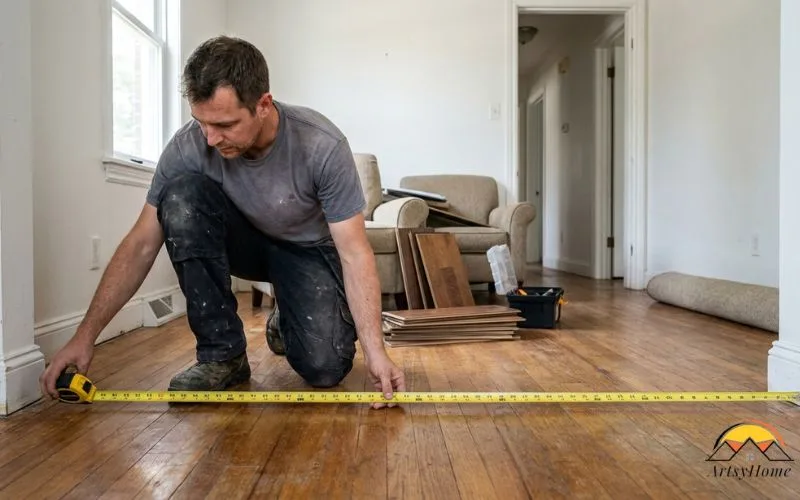
If you’re shopping for new floors, pretty much every price tag and box label comes back to one little unit, so it helps to know exactly what a square foot in flooring means. It’s a patch of floor 12 inches long and 12 inches wide, which equals 144 square inches.
Multiply a room’s length by its width in feet and you’ve got its total. Then comes the extra for waste and rounding up to whole boxes, and honestly, that’s where the expensive mistakes happen.
Table of Contents
How Flooring Is Measured
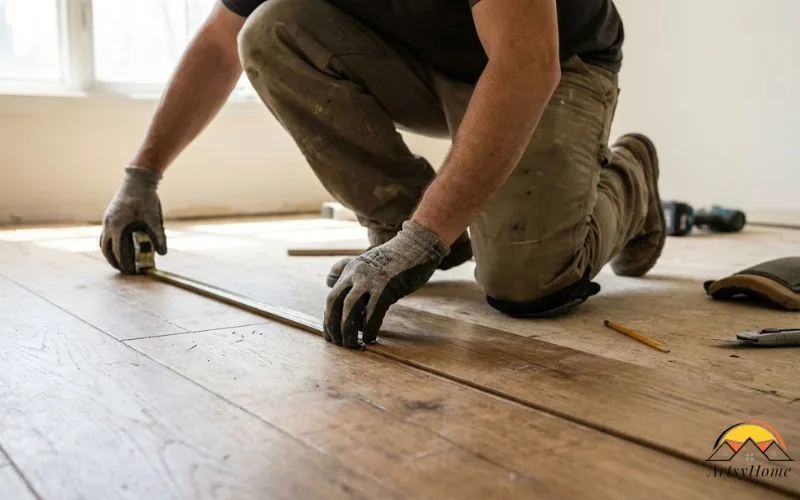
A square foot is the area of a square that’s 1 foot (12 inches) on every side. That’s 144 square inches, and 9 of them make a square yard (NIST Handbook 44, 2026). Hard floors are priced per square foot, and every box tells you how many square feet it covers.
The shape doesn’t actually matter; only the area does. A skinny strip 6 inches wide and 24 inches long also covers 144 square inches, so it counts as a full square foot. For smaller pieces, multiply the two sides in inches and divide by 144; a 12-by-18-inch tile is 216 square inches, which comes to 1.5 square feet.
One word causes a bit of confusion. Roofers talk about a “square,” but that’s a 10-by-10-foot area, or 100 square feet. Flooring doesn’t use it. Planks and tile are priced by the square foot, and carpet is sometimes quoted by the square yard instead.
| Floor size | Square feet | Square yards |
| 10 × 10 ft | 100 | 11.1 |
| 12 × 12 ft | 144 | 16 |
| 15 × 15 ft | 225 | 25 |
| 12 × 18 in tile | 1.5 | 0.17 |
How to Calculate Square Footage for Flooring
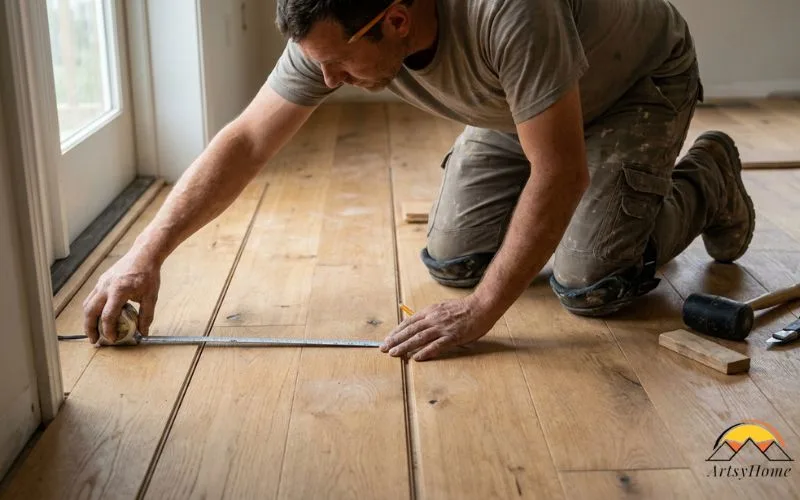
- Measure the length and width of each space, turn any inches into decimal feet, multiply, and add all the spaces together. This is the order we’d go in: Measure wall to wall at the longest and widest points. Carpet One suggests rounding each measurement up to the nearest inch.
- Turn inches into feet by dividing them by 12. In Carpet One’s example, 12 feet 7 inches becomes 12.583 feet.
- Multiply length by width. A room that’s 12.583 by 9.5 feet comes to 119.54 square feet.
- Split L-shaped or odd rooms into rectangles, work out each one, and add them up, the same way Home Depot handles a room with a nook.
- Add the closets, hallway and anything else getting the same floor, and measure into doorways so the new floor meets the next room.
Our tip: sketch the room on scrap paper first, so the pantry and coat closet don’t get forgotten. Rather skip the arithmetic? Our free Square Footage Calculator handles rectangles, L-shapes, triangles and circles, though any floor calculator only gives you area. The waste and box math below is still on you.
How Much Flooring Do I Need?
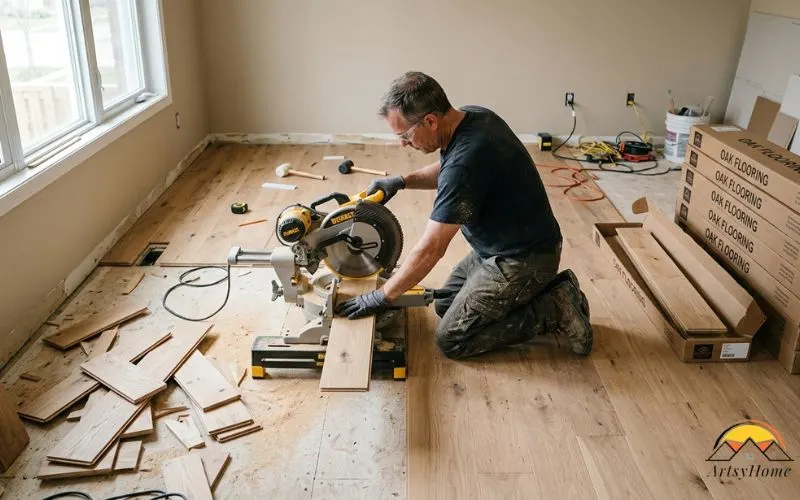
Order your measured square footage plus a waste allowance, then round up to full boxes. For most hard floors in a simple room, somewhere around 5 to 10% extra is the usual starting point.
That extra covers cut ends at the walls, pieces that snap, and boards you reject for looks. Here’s where the common allowances come from:
| Situation | Starting allowance | Source |
| Standard hard flooring, simple room | 5 to 10% | Carpet One, 2026 |
| Solid hardwood, standard install | 5% cutting allowance | NWFA, 2002 |
| Engineered hardwood, one maker’s advice | 5 to 15% | BHW Floors, 2024 |
| Carpet | 10 to 20% | The Home Depot; Carpet One suggests 20% |
Hardwood has a little twist of its own. For tile, we’d start at the top of that 5 to 10% range and go higher from there if the layout runs on a diagonal or the room is full of cuts. Small bathrooms are the classic case (you’ll see plenty in our small bathroom ideas), because every tile around the toilet, tub and vanity gets trimmed. Your tile setter should confirm the final number once they’ve seen the layout.
Here’s how the math plays out for a 15 by 15 foot room with 10% extra:
- 15 × 15 = 225 square feet
- 225 × 1.10 = 247.5, so call it 248 square feet
- One Pergo laminate listed at The Home Depot covers 19.63 square feet per case (The Home Depot)
- 248 ÷ 19.63 = 12.63, which means you buy 13 boxes
Always round up. You can’t buy part of a box, and a second order later on might not match the color of your first batch.
How Flooring is Sold
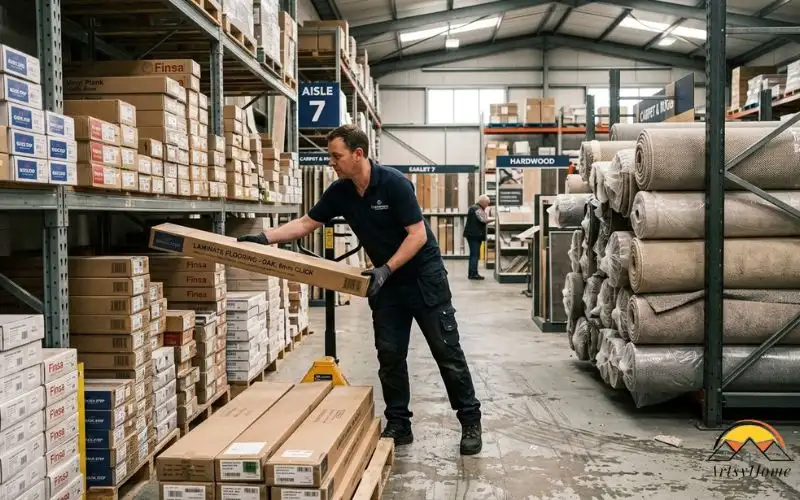
Planks and tile come in boxes with a set coverage, while carpet and sheet vinyl get cut off a roll. That changes how much you end up paying for compared with how much floor you actually cover.
Boxes and Cartons
Every box lists its coverage in square feet, and it’s almost never a round number. That Pergo laminate from earlier covers 19.63 square feet per case, which is why we’d never plan around a “typical” box size. Use the label on the exact floor you’re buying, and do the division with that number.
Carpet Rolls
Carpet comes off a roll, so the roll width decides what you pay for. HomeAdvisor says 12 feet is the most common width, with 13.5 and 15-foot rolls around too.
That’s where people get caught out. In HomeAdvisor’s own example, a 10-by-10-foot room needs a 12-by-10-foot piece cut from a 12-foot roll, so you cover 100 square feet but pay for 120. On top of that, the Carpet and Rug Institute’s residential standard tells installers to allow at least 3 inches at each wall for trimming, plus extra when a pattern needs matching.
Square Feet to Square Yards
Divide square feet by 9 and you’ve got square yards. Carpet One’s 119.54 square foot room works out to 13.28 square yards. To compare prices, multiply a per-square-foot price by 9, so a carpet at $3 a square foot is the same as $27 a square yard. Check the unit on every quote.
How to Measure Stairs for Flooring
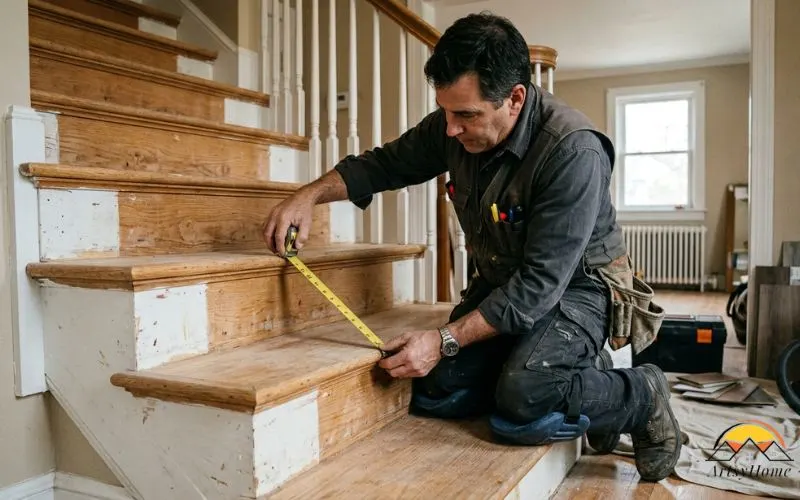
Stairs get measured one step at a time: the rise plus the run plus a bit extra for the nose, multiplied by the number of steps and then the width. HomeAdvisor’s carpet example goes like this:
- 7 inch rise + 7 inch run + 2 inches for the nose and overage = 16 inches per step
- 16 inches × 13 steps = 208 inches
- 208 ÷ 12 = 17.33 feet, rounded up to 18
- 18 feet × a 4 foot wide staircase = 72 square feet
- Add a 4-by-4-foot landing (16 square feet) and you’re at 88 square feet
Curved staircases are a job for a pro. For planks or tile on stairs, ask whether treads and nosing are priced per step or per square foot.
How Much Does 200 Square Feet of Flooring Cost?
Roughly $800 to $3,000 installed. The material you pick drives most of that spread. For bigger jobs, the installed ranges look like this:
| Floor size | Installed cost (HomeGuide, 2026) |
| 200 sq ft | $800 to $3,000 |
| 1,000 sq ft | $4,000 to $15,000 |
| 1,200 sq ft | $4,800 to $18,000 |
| 1,500 sq ft | $6,000 to $22,500 |
Frequently Asked Questions
How much flooring do I need for 1,000 square feet?
Plan on 1,050 to 1,100 square feet of material, using the usual 5 to 10% overage. Then divide by the coverage printed on your box and round up. A big open room with few corners can sit at the low end, while lots of closets, doorways and hallways push you toward the high end.
Should I keep leftover flooring?
Yes, keep at least one full box, stored flat, for repairs down the road. A later batch might not match the color of your original order, so spares from the same lot are the safest fix for a damaged plank or cracked tile. Unopened tile boxes can often be returned, too.
Do I need the same square footage of underlayment or carpet pad?
Pretty much, yes. HomeAdvisor says you need equal amounts of carpet and padding, although installers trim the pad back a couple of inches from the walls to make room for tack strips. Some planks come with a pad already attached, so check the box before you buy a separate layer.
Is my home’s listed square footage the same as my flooring square footage?
No, and it can be off by a fair bit. Listing and appraisal figures usually follow the ANSI Z765 standard, which measures a house from the outside of its exterior walls (ANSI Z765), so the number includes wall thickness and spaces you’d never floor the same way. Always measure the actual floor inside each room before you order.
The number that actually matters
What you pay for is the amount you order, which is always more than the room’s raw size. Get your area from our Square Footage Calculator, add waste from the table above, round up to full boxes or a full roll, and take that number to three installers.