

In the world of private real estate, outdoor spaces have evolved from being mere extensions of the home to becoming integral features that enhance liveability, aesthetics and property value. Fire pits are among the most notable of these features, offering versatility in fostering social gatherings, providing warmth, and creating focal points in backyards or patios.
Homeowners and designers seeking customisation can use DXF (Drawing Exchange Format) files to create precise, scalable designs. Widely used in computer-aided design (CAD) software, this format allows for the creation of detailed blueprints that can be fabricated using CNC machines, laser cutters, or traditional metalworking techniques.
Integrating DXF-based fire pit designs into private property development enables the creation of bespoke solutions that align with architectural styles, landscape integration, and functional requirements. This article explores the technical aspects of using DXF files for fire pit design, their application in residential settings, and their broader implications for enhancing private real estate. For a practical example, see this DXF file for fire pit
Table of Contents
Understanding DXF files in design contexts

DXF files act as a universal medium for the exchange of 2D and 3D drawing data between different CAD programmes. Developed in the 1980s, this format supports layers and entities such as lines, arcs and polylines, as well as attributes that define materials and dimensions.
In the context of fire pit design, for example, a DXF file encapsulates the geometric blueprint of the structure, including the base, walls, drainage features and decorative elements. For example, a basic circular fire pit could be represented by concentric circles for the inner and outer rings, with radial lines showing support structures or ventilation slots.
The advantage of DXF over other formats is its compatibility and ease of editing. Designers can import DXF files into software suites and modify parameters such as diameter, height or material thickness without losing precision. This is particularly important in the context of private real estate, where fire pits must comply with local building codes, zoning regulations and site-specific constraints.
For instance, in suburban homes, a DXF file can be adjusted to fit within a compact backyard, ensuring that the fire pit does not encroach upon property lines or utility easements. Expert designers often start with parametric modelling, defining variables such as radius or wall angle, which allows for rapid iterations to suit different residential layouts.
From a technical standpoint, creating a DXF file for a fire pit involves several steps. First, outline the main shape, which is usually a circle, square or hexagon, using polyline entities to create smooth curves. Then, add layers for the different components: one for the fire bowl, one for the base and separate ones for accessories such as grates or spark screens.
Dimensions are annotated using text entities, with measurements specified in inches or millimetres. Hatches can represent material fills, such as stone or metal. For 3D-capable DXF variants, extrusions and solids can be used to create volumetric representations, which are useful for simulating heat distribution or structural integrity.
In private real estate projects, DXF files can facilitate collaboration between architects, landscapers and fabricators. For example, a homeowner renovating a mid-century modern residence might use a DXF file to design a minimalist, rectangular fire pit that echoes the linear façade of the home.
This digital blueprint ensures the final product integrates seamlessly with existing hardscaping, such as patios or retaining walls. This increases the property’s curb appeal and market value.
Design principles for fire pits tailored to residential properties.
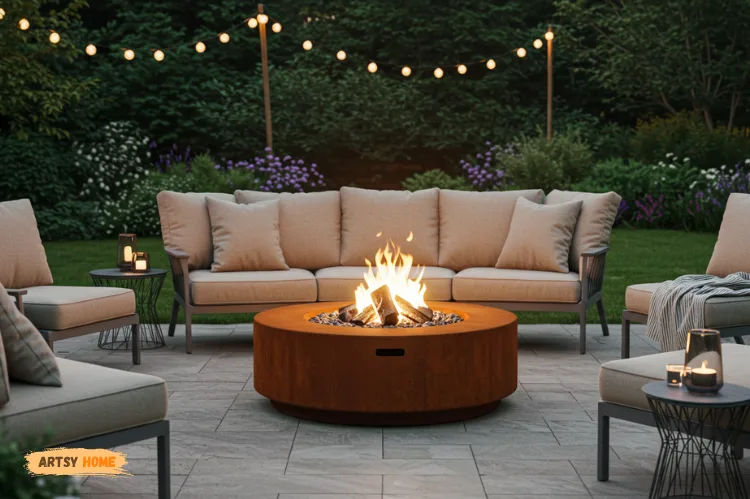
When designing fire pits for private residences, functionality and safety are of the utmost importance. DXF files enable meticulous planning to address these concerns. Consider the scale: For a typical single-family residence with a 0.25-acre plot, an ideal fire pit diameter is 36–48 inches, providing ample seating space without overwhelming the yard.
The DXF file can incorporate ergonomic details such as a 12–18-inch ledge for seating, which can be drawn as offset polylines from the main ring.
The material selected through DXF annotations influences both durability and aesthetics. Popular options include Corten steel for a rustic patina and cast concrete for a contemporary look. The file specifies thicknesses (e.g. 1/8 inch for metal sheets) to withstand thermal expansion.
Ventilation is essential to prevent smoke build-up, and DXF designs often incorporate perforated patterns, such as arrays of circles or slots, positioned at the base to promote airflow. For gas-powered variants, the file may include details of pipe routing and burner placement to ensure compliance with residential gas line standards.
In the context of private real estate, custom fire pits designed using DXF files can transform underused backyards into outdoor living spaces. In upscale neighbourhoods, such features are associated with higher property valuations as they extend the usable space all year round.
Real estate appraisals often take outdoor amenities into account, and well-designed fire pits can add 5-10% to a home’s value by enhancing its entertainment potential. For example, in coastal properties that are prone to evening chills, a DXF-customised fire pit with wind barriers (modelled as curved extensions) would be a practical addition, making the home more attractive to buyers seeking lifestyle enhancements.
Expert considerations also extend to environmental integration. DXF files enable topographic mapping, allowing the base of the fire pit to be contoured to match the slopes common to hillside residences.
By using spline entities for irregular shapes, designers can create organic forms that blend with natural landscapes, thereby reducing erosion risks and promoting sustainability. In eco-conscious private developments, biofuel-compatible designs with DXF-specified modular inserts align with green building practices and appeal to environmentally aware homeowners.
Fabrication and implementation in private real estate.

Once a DXF file has been finalised, the fabrication process turns digital designs into physical reality. CNC plasma cutters and water jets can interpret the DXF file directly, creating precise cutting paths in metal sheets. For concrete fire pits, the file guides the creation of formwork via 3D printing or milling. This process minimises waste and errors, which is crucial for cost-effective residential projects where budgets are often limited.
In private real estate, implementation involves site preparation. DXF files aid excavation planning, providing dimensioned views that show the required depth (typically 15-30 centimetres for gravel bases) to ensure stability on different types of soil. Drainage features such as sloped bases or weep holes are designed to prevent water from pooling, which is a common issue in rainy climates and could otherwise lead to property damage.
Safety integration is non-negotiable. DXF designs must incorporate clearances of at least 10 feet from structures or overhangs, as required by fire safety regulations. Spark arrestors, represented as mesh layers in the DXF file, mitigate the risk of embers, particularly in wooded residential areas. For families with children, raised edges or barriers can be added; the DXF file can be used to perform stress analysis simulations to verify load-bearing capacity.
Case studies from residential projects demonstrate effectiveness. For example, in a suburban remodelling project, an octagonal fire pit based on a DXF file was integrated into a patio extension to align with existing walkways. This boosted both the home’s functionality and its resale potential, as outdoor gathering spaces are in high demand in the post-pandemic real estate market. Similarly, on luxury estates, DXF enables multi-level designs with integrated seating to create terraced effects that maximise views and privacy.
Advanced techniques and future trends
Advanced DXF techniques can elevate fire pit designs for expert practitioners. Parametric scripting within CAD environments enables dynamic adjustments, such as linking dimensions to location-specific variables like yard size or wind patterns. 3D DXF extensions support finite element analysis (FEA) for thermal stress, ensuring that the structure can withstand repeated heating cycles without warping.
In the context of smart homes, which are a growing segment of the private real estate market, DXF files can incorporate Internet of Things (IoT) integrations. Sensor placements for automated ignition or temperature monitoring can be mapped to facilitate seamless embedding during fabrication. This tech-forward approach is appealing to modern homeowners and could increase the desirability of properties in competitive markets.
Looking ahead, the intersection of DXF with emerging technologies such as augmented reality (AR) has the potential to transform applications. For example, homeowners could use AR apps to visualise DXF-rendered fire pits overlaid on their property, which could aid decision-making before construction. Sustainability trends favour recycled materials, and DXF can optimise cuts to reduce scrap, which aligns with green certifications that can enhance real estate value.
Moreover, in multi-unit private developments such as gated communities, standardised DXF templates ensure uniformity while allowing customisation per plot. This strikes a balance between communal aesthetics and individual preferences, thereby fostering neighbourhood cohesion and long-term property appreciation.
Challenges and best practices

Despite the advantages, there are challenges. For example, if not optimised, DXF files with intricate designs can lead to fabrication errors. Best practice: Use layer management to isolate components and validate files by exporting and importing them across different software programmes.
In the private real estate sector, the regulatory hurdles you face can vary depending on your location. Experts recommend cross-referencing DXF designs with municipal codes at an early stage, making adjustments as necessary for setbacks or emissions standards. Simulating material usage in the file can mitigate cost overruns and enable accurate quoting.
Ethical considerations include accessibility. Designs should be inclusive of diverse users. For example, DXF could be used to create ramps or adjustable heights to make fire pits wheelchair-friendly in inclusive homes.
DXF files facilitate the creation of bespoke fire pits, combining technical precision with aesthetic and functional enhancements to private residences. They enhance property value, improve lifestyles and promote sustainable living by enabling customised designs that blend with home landscapes.
In an ever-changing real estate landscape, adopting such digital tools ensures that outdoor spaces remain dynamic assets that can be tailored to the unique needs of homeowners. Whether for cosy family evenings or grand entertaining, a well-designed fire pit born from a DXF blueprint embodies the essence of thoughtful residential design.
Read Next: 25 Stunning Low Budget Backyard Designs With Gravel

